

The first thing Moose chewed that I actually cared about was the back leg of my kitchen table. He came home from a Myrtle Beach shelter in early March, about four months old and all legs and ears, and the thing that eventually ended his furniture phase was a KONG Extreme, the Large size, bought two weeks after he arrived, right after he got my husband Gary's slippers. I did not know that when I bought it. I bought it because I was tired and the slippers were the last straw.
Before that, I tried what people tell you to try. I said no in a firm voice. I moved the slippers to the top of the closet. I wiped the table leg with a bitter spray, which Moose licked once, thought about, and then ignored. What I did not understand yet is that a teething puppy chewing on furniture is not being defiant. His mouth hurts and his brain is busy and chewing is the thing that settles both. Saying no takes the job away and leaves him with nothing to do instead. What finally worked at our house was giving him something better to chew and making sure it was ready before he needed it.
I want to be straight about who is writing this. I am not a trainer, a behaviorist or a vet. I am a retired dental office manager who reads every label and keeps a notebook, and this is one dog in one ranch house in South Carolina. It helped us. It will not suit every dog, and if your puppy is chewing holes in drywall or hurting himself, close this page and call your vet or a certified trainer instead.
The one chew toy that outlasted my puppy's table leg phase
I bought the Large KONG Extreme in mid March for a four month old mixed breed who was chewing everything within reach. It is the same one in my freezer today, and I have not had to replace it.
Amazon Check Today's Price on Amazon →Step 1: Write down when the chewing happens before you buy anything
I spent one week doing nothing but keeping notes, and it turned out to be the most useful week of the whole project. Every time Moose put his mouth on something he should not have, I wrote down the time and what was going on. By Friday the pattern was almost embarrassing in how obvious it was. The table leg got it between six and eight in the evening. The slippers got it when I was on the phone and not watching. The rug corner got it after a long nap, before he had been outside.
Three different jobs, three different answers. The slippers were pure opportunity, so the slippers went into the closet. The rug corner was a full bladder, so we went outside first. The evening table leg was the hard one, and it was not teething in the simple sense. He was wound up and had nothing to put in his mouth. Puppies do a lot of their worst chewing in the hour before they finally crash, which is the same hour I used to sit down and finally relax.
Puppies also chew harder while the adult teeth are coming in, which for Moose ran from about four months to about seven. That part fades on its own. It fades a lot more comfortably for everyone if the puppy has a legal thing to chew while it happens. If your dog is past his first birthday and the chewing is new and constant, that is a conversation with your vet rather than a trip to the pet store.
Step 2: Size up rather than down, and check it every day
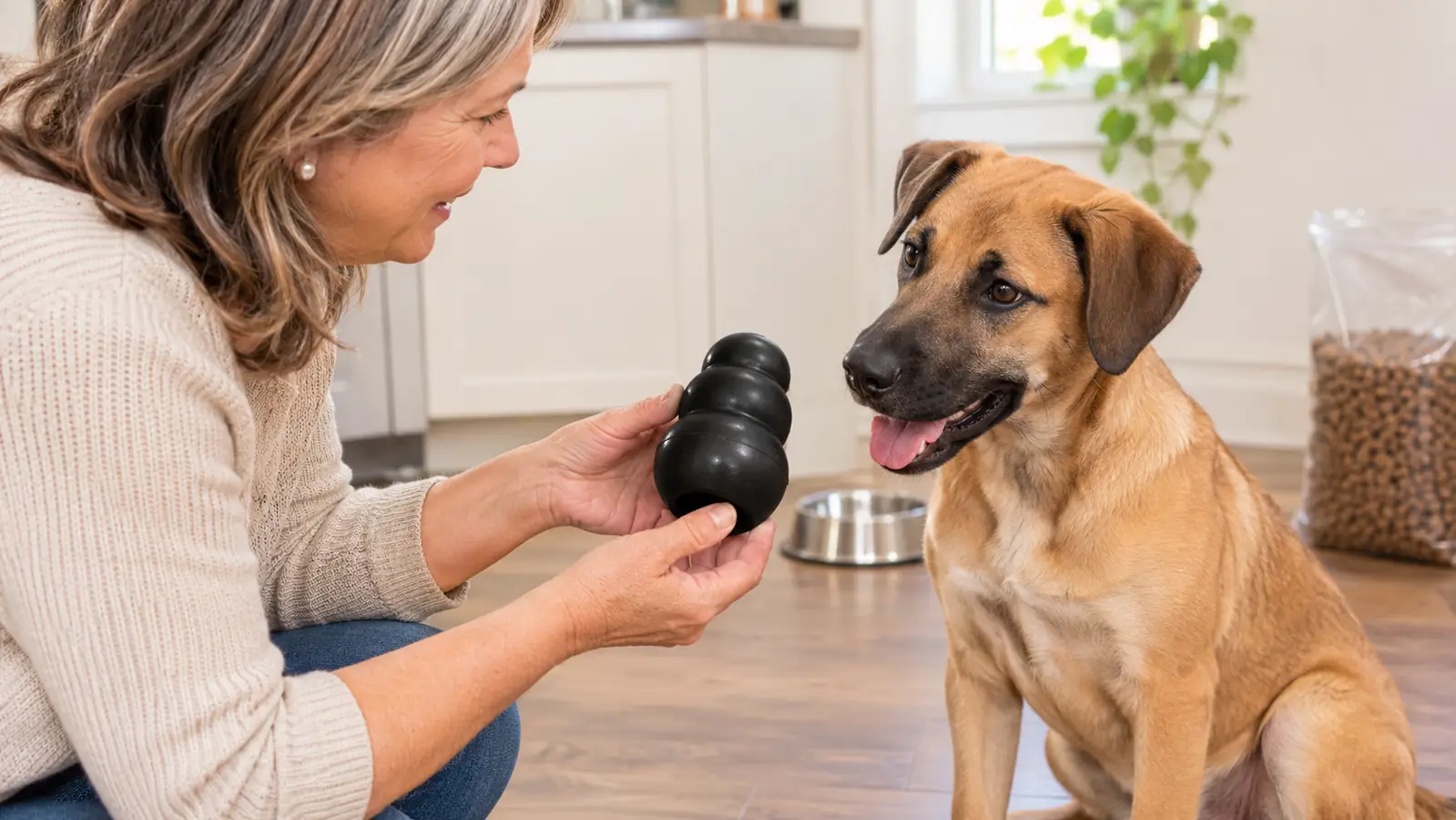
The listing recommends the Large for large breeds. Moose is about 45 pounds now and was maybe half that when the box arrived, so it looked too big for him and I nearly sent it back. What changed my mind was watching him try to get his back teeth on the table leg. A puppy that age chews for the back of his mouth, and a toy he can only nibble with his front teeth does not scratch that itch. The Large gave him something to really work on.
It is one piece of rubber with a hollow inside. No squeaker, no stuffing, no rope to fray, nothing sewn on that a determined puppy could pull off in the first hour. That was most of the appeal for me, because every chew toy I had tried before had a weak point and Moose found it. This one has no weak point I can see, which is not the same as saying it cannot be damaged.
I check it every time I hand it over. I look for cracks, for missing chunks, for a spot that has gone soft. The listing calls it durable and it has been, but no chew toy is indestructible and I would not trust a brand that claimed otherwise. If yours gets damaged, it goes in the trash that day. I would size up as a puppy grows rather than down, because a toy that is too small is the one that gets swallowed.
Step 3: Stuff it with his own dinner and freeze it
A plain rubber toy holds a puppy's attention for about four minutes. A frozen one holds it for forty. The hollow inside is the whole point, and the cheapest stuffing is the food he was going to eat anyway. After his evening meal I take a portion of his kibble, soak it in warm water until it softens, spoon it into the opening, cap it with a thin layer of peanut butter, and set it on a small plate in the freezer.
It goes in solid overnight. By the next afternoon it is ready, and I hand it to him when the evening restlessness starts rather than after the table has already been chewed. The first time, he did not know what to do with it. I sat on the kitchen floor and held it while he licked at the opening, and after that he was sold.
Two things I check on the label. Peanut butter sometimes contains xylitol, which vets warn about with dogs, so I buy a brand that does not and I read the ingredient list every time, because formulations change. I also count the stuffing as part of his daily food rather than extra, so he does not turn into a barrel with legs. If your dog has allergies or a prescription diet, ask your vet before you start adding anything.
The same chew toy I bought in mid March for a four month old puppy is in my freezer right now, and not one piece has come off it.
Step 4: Hand it over early, and pair it with the crate
The mistake I made for the first week was waiting. I would hear the chewing start, come running, take the table leg away and then go find the toy. By then he was already wound up and the swap felt like a punishment. Now the toy comes out at five thirty, before he has a chance to look around for something to destroy. It is a small change in timing and it made a bigger difference than anything else on this list.
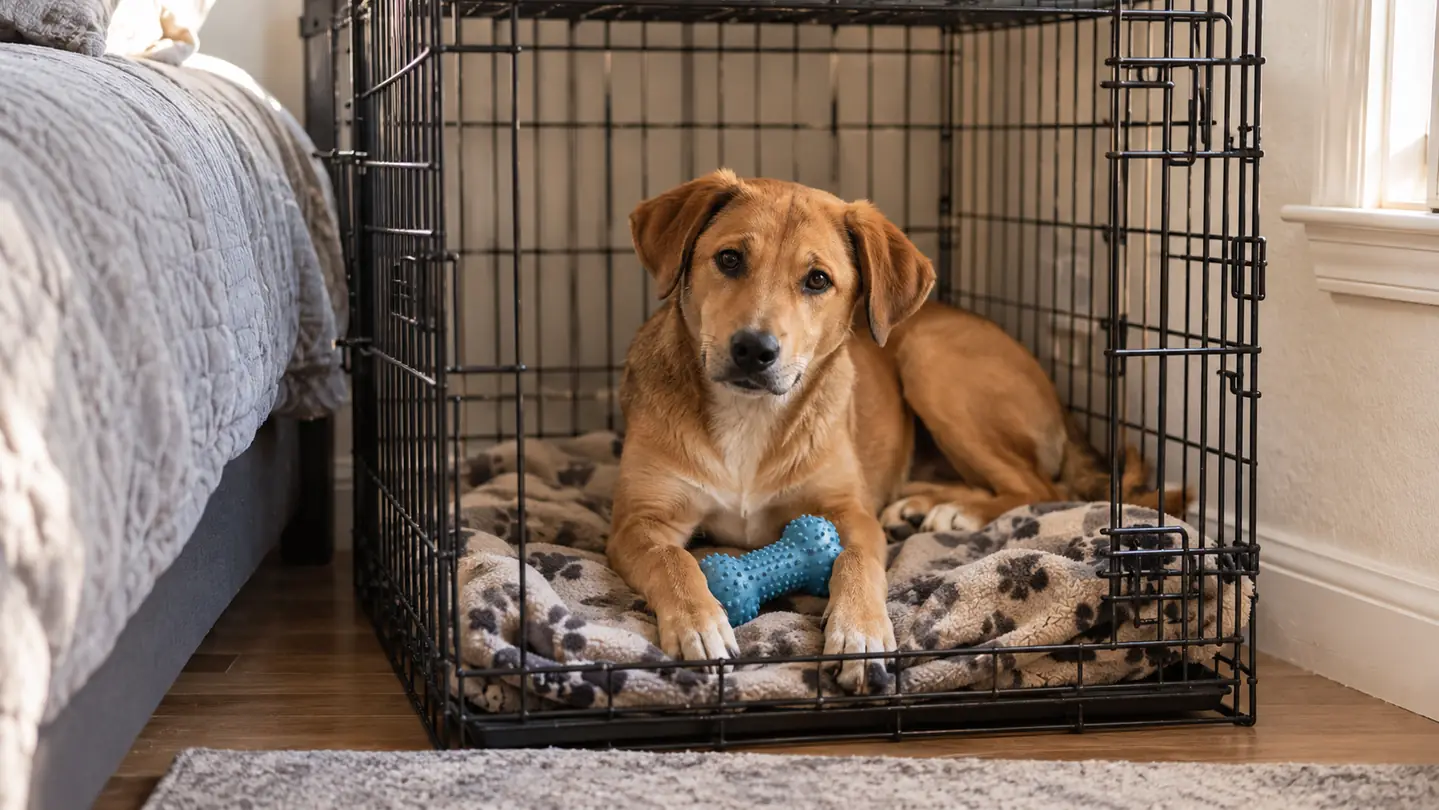
It also became the thing he gets when I leave. Moose sleeps in a MidWest iCrate in the corner of our bedroom, and he gets the frozen KONG in the crate when I run errands. That was not a training plan so much as a trade. He gets something good in the place I need him to be, and I get to walk out the door without listening to him complain. It took a few weeks before he started walking in on his own, and the toy was part of why.
One rule I made for myself: I did not leave it with him loose in the house until I had watched him work on it for a good while. In the crate, yes. Alone on the living room rug, not until I trusted him. You know your dog. I did not know mine yet, so I supervised.
Step 5: Make the rest of the house boring and the routine the same
A chew toy cannot fix a house where the good stuff sits at nose height. I put the shoes in the closet, moved the trash can behind a cabinet door, and rolled up the hallway rug for a month. I did not do that out of discipline. I did it because every time Moose chewed something he should not, he practiced the habit, and I was tired of practicing.
When I caught him mid chew, I did not yell. I said his name, waited for his head to come up, and put the KONG in front of him. If he took it, he got a quiet 'good.' If he went back to the chair, I stood up and we went outside for three minutes instead, because sometimes the answer is not a toy, it is a change of scenery. What I never did was scold him after the fact. He does not connect a yelling person to a chewed table leg twenty minutes later. He just connects me to being scary.
And I will say the thing a toy cannot do. If your puppy is chewing constantly, panting, pacing, unable to settle even with a stuffed frozen toy, or chewing himself raw, that is beyond what a rubber chew toy is for. It might be pain, it might be anxiety, and either way it is a call to your vet or a certified trainer rather than another trip to the pet store. I say that as someone who bought one toy and got lucky with it.
What Else Helps
The KONG did the heavy lifting on furniture in our house, but it only worked because the day around it changed. Moose gets two walks, a morning one around the neighborhood and an evening one that is mostly sniffing. A tired dog with a full nose chews less. The LickiMat comes out when I need him to settle rather than destroy, a thin layer of plain yogurt or wet food, given to him on the kitchen floor while I sit nearby. He is never left alone with it, and I wash it in the sink afterward.
The clicker came later and it is for manners, not chewing, though a dog who knows what to do with himself is a dog who gets into less. The harness is for the walks, and the walks are half of the chewing answer. What I would tell you at my kitchen table is simpler than any of that. Buy one good chew toy, stuff it with his dinner, freeze it overnight, and hand it over before the trouble starts. Then fix the rest of the day around it. That is the whole method, and it took me a chewed table leg to learn it.
If your puppy is chewing the furniture right now, start with the freezer
The Large KONG Extreme is the chew toy I would buy again tomorrow. Stuff it with soaked kibble, add a thin cap of peanut butter, freeze it overnight, and give it to your puppy before the evening restlessness starts.
Amazon Check Today's Price on Amazon →