
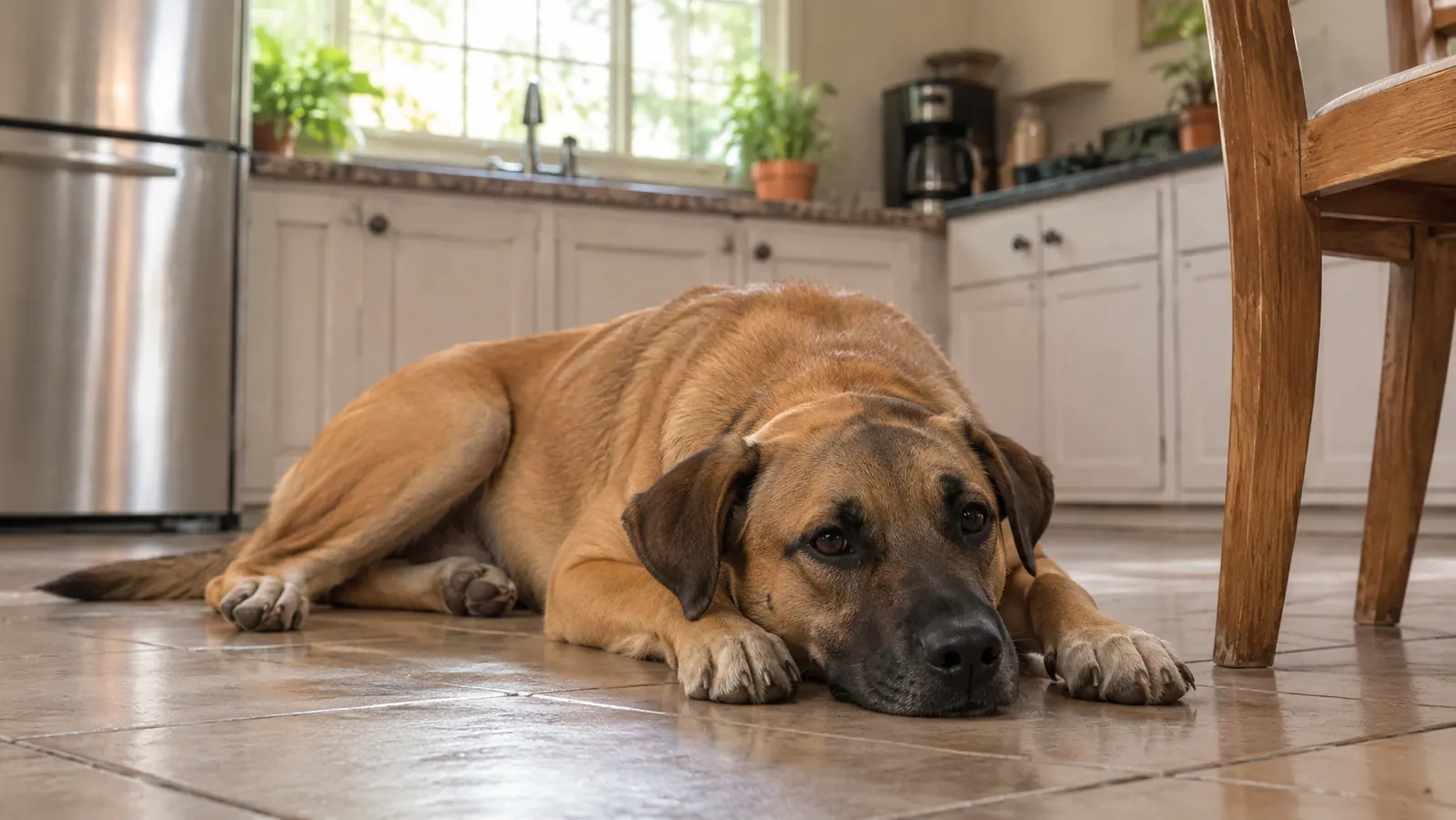
Moose came home in early March 2026 at about four months old, and for the first ten nights he cried in the crate. That settled down on its own. Then in April I started leaving him for short errands, and it came back. Not screaming, nothing dramatic, just a low steady complaining that started the second the front door clicked shut. My husband Gary works in the back room and he would tell me later that it went on for a few minutes after my car pulled out of the driveway. Coming home to that is a particular kind of guilt, and it made me a little stupid about errands. I started taking Moose with me to places a dog has no business going, just to avoid the sound of the door.
I am not a trainer. I am 57, retired from a dental office, and Moose is the first dog I have trained myself as an adult. The thing that turned the corner for us was not complicated, and one piece of it was a LICKIMAT Classic Soother and Buddy two-pack: two square rubber mats with textured surfaces that you smear something soft onto. It is not a fix. It is ten minutes of something to do with his mouth so the rest of the routine can happen without him following me around. Everything here is from a one-story ranch house in Myrtle Beach, a small fenced back yard, one dog, and a husband who does not want to hear about reinforcement schedules at dinner. The other piece was five small steps, practiced separately, instead of one large event called leaving.
The Mat I Put Down Before I Pick Up My Keys
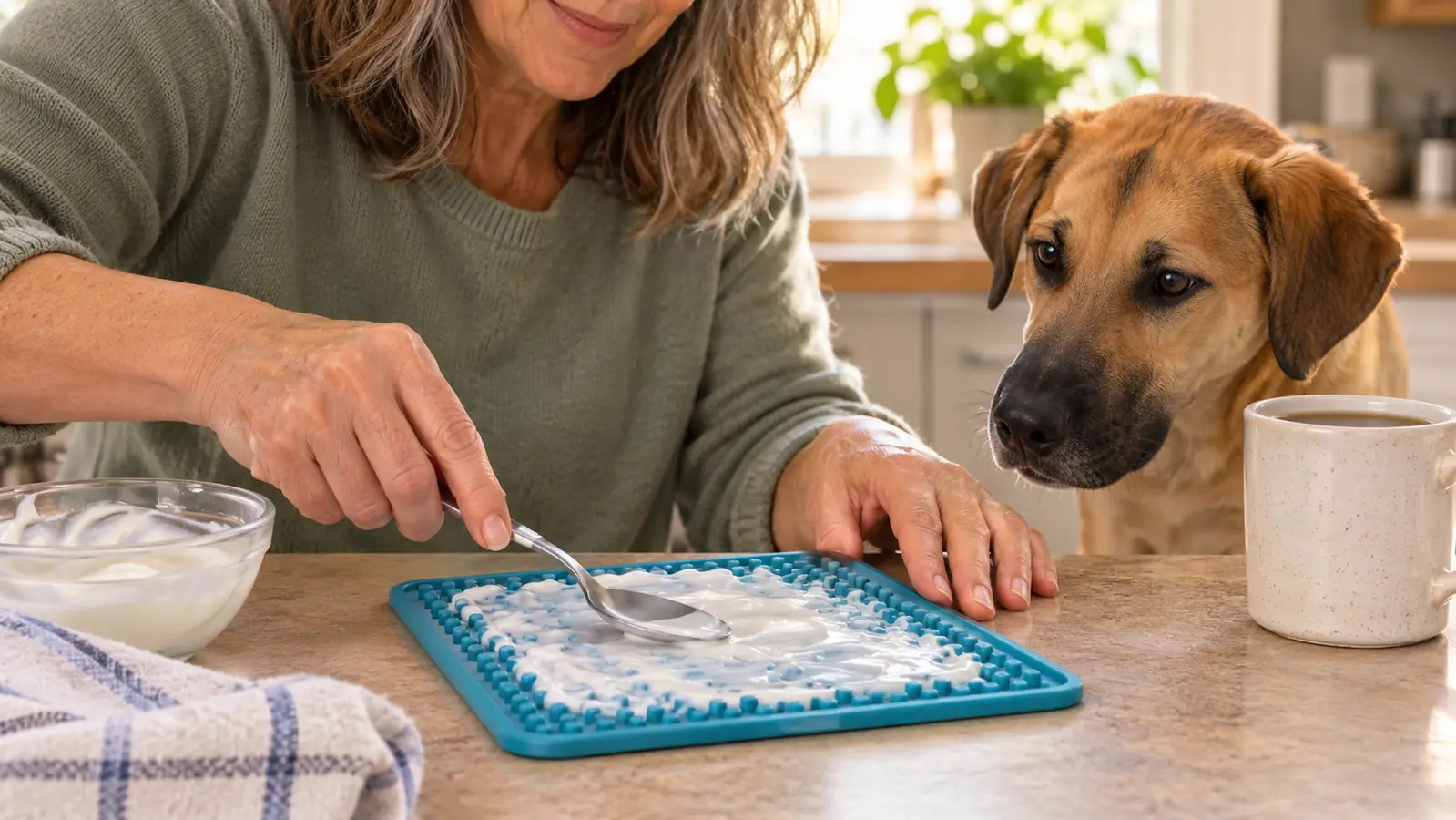
Two square mats, one in the sink and one on the floor. A thin smear of plain yogurt or wet food, hand wash only, and picked up before the door opens.
Amazon Check Today's Price on Amazon →The Five Steps, In the Order I Did Them
This took about seven weeks, and I redid step three twice. If your dog is less bothered than Moose was, you can move faster. If he is more bothered, read the last paragraph of step five before you start, because a mat and a routine are not the right tool for every dog.
Step 1: Start the mat when nothing is happening
The mistake I nearly made was handing Moose a mat for the first time on my way out the door. That teaches a dog that the mat means you are about to leave, which is the opposite of what I wanted. So I put it down on a Tuesday afternoon in April with nothing on the calendar. I spread a thin layer of plain yogurt over the surface with the back of a spoon, set it on the kitchen tile, and sat in the chair by the window with my crochet bag like it was any other afternoon.
Thin is the whole point. My first attempt was a proper glob of peanut butter and it was gone in under two minutes, which buys you nothing. A thin smear he has to work at keeps him busy for eight or ten minutes. When I want it to last longer I spread it and put the mat flat in the freezer for an hour first. The listing says the textured surface slows the licking down and that licking is supposed to help with saliva and, over time, with teeth. I cannot vouch for the dental part. I can tell you he is quiet while he works at it, and quiet was what I was short on.
The first sessions were short on purpose, three or four minutes and then I picked the mat up. A mat that lives on the floor all day stops being an event. The two LICKIMAT mats in the pack do not have the same surface pattern, and Moose works one of them noticeably longer than the other, which I cannot explain, so that is the one he gets when I need the full stretch. They are 8 inches square, about seven ounces each, they sit flat in the bottom of the kitchen sink, and the care instructions on the listing say hand wash only, so that is what happens here, warm water and a drop of dish soap, then stood up against the rack to dry.
Step 2: Hook the mat to the fifteen minutes before you leave
Once Moose was cleaning a mat without stopping to check where I was, I moved it to the front end of the errand. The order in this house is fixed now. Mat down on the kitchen floor, then I fill my water bottle, find my keys, put my shoes on, and pick the mat up. The door opens last.
Two reasons I pick it up instead of leaving it down. The first is that it is a rubber mat and not a chew toy, and Moose was still a young dog with strong opinions about what could be eaten. The second is that I want the mat to mean I am still in the house. If it is the last thing he sees as the door closes, I have turned it into a departure signal, which is exactly what I was trying to avoid.
The ten minutes matter more than they sound. A dog who has been licking for ten minutes is not in the same frame of mind as a dog who has spent ten minutes watching you put your shoes on. For the first two weeks I could not see any change and I nearly quit. Around week three I noticed he had stopped following me to the door while I got ready. He would hear the fridge and go stand over the spot on the tile where the mat goes. That happened before the complaining changed at all, and it was the first real evidence that the routine was doing something.
He stopped following me to the door around week three, before the complaining changed at all. The routine moved first. The feelings caught up later.
Step 3: Practice the door in pieces too small to be scary
The actual leaving is its own skill and I had to teach it separately from the mat. I started with thirty seconds on the porch with the door shut. Not a walk, not an errand, just me standing out there looking at the mailbox like a woman with nothing to do. Then two minutes down to the mailbox. Then five minutes around the block. I stayed at each length for several days before making it longer.
For the real absences the mat is not involved, because I pick it up on the way out. What goes with him is the crate with the door closed and a frozen KONG, which is what we had already been using for errands since March. I turn a radio on low in the bedroom. That is the whole setup. Mat before, KONG during, a calm and boring return after. I do not make a production of coming home, because a big greeting teaches a dog that being alone was a crisis worth celebrating the end of.
I broke this rule once. I was running late and gone a bit under an hour instead of the ten minutes we had been practicing. He was fine, technically. The next two departures he complained at the door again, and it took me another week to get back to where we had been. If you take one thing from this article, take that one. A single jump forward costs more time than four small ones.
Step 4: Change the order so your keys stop meaning gone for hours
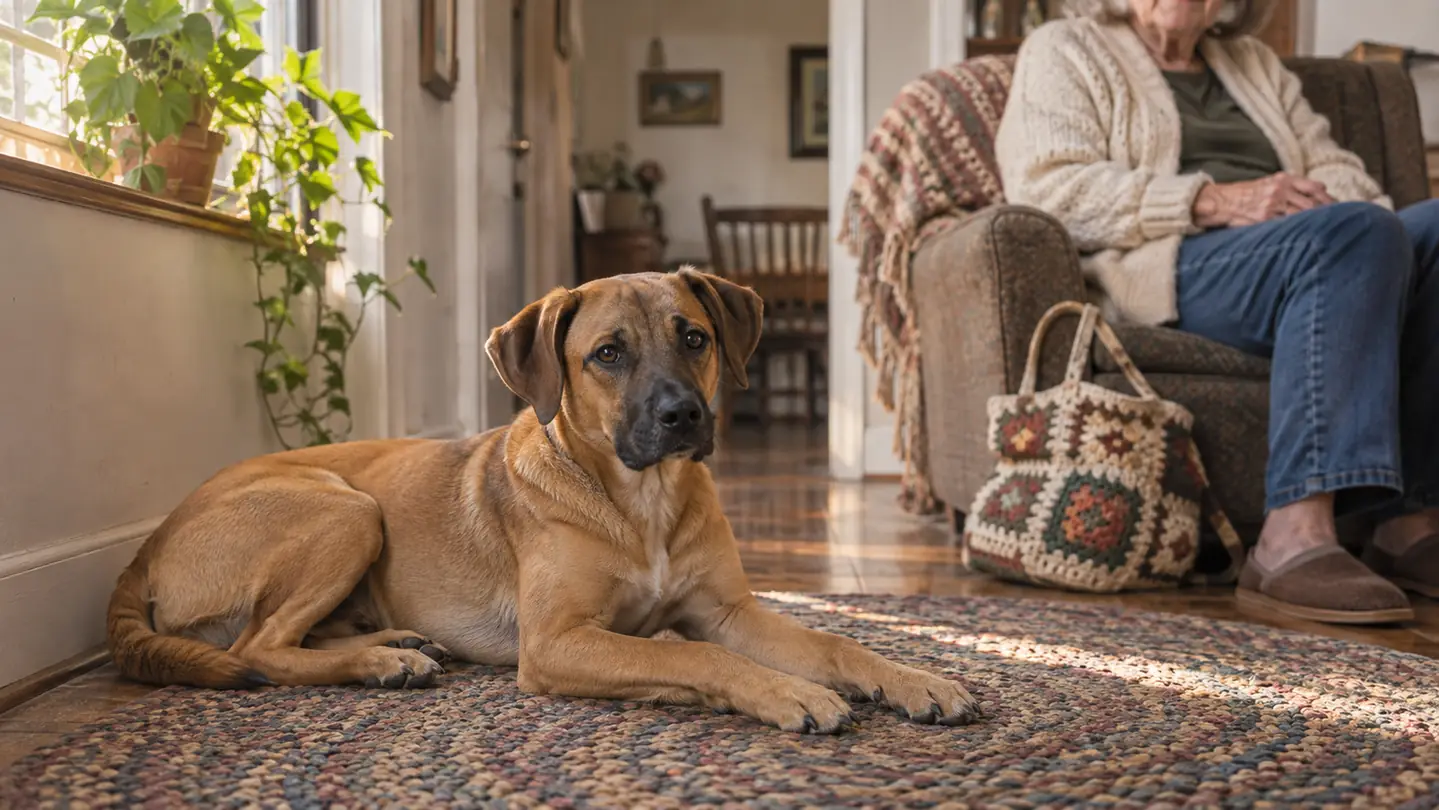
By week five Moose had learned the sound of my keys. Dogs are good at that and bad at nuance. So I started picking the keys up and putting them back down. Shoes on, coffee made, sit down on the couch. Coat on, take the trash out, come back inside thirty seconds later with the mat still on the floor.
Gary leaving for work was the free practice I did not plan. He goes out the same door at the same time five mornings a week. I started putting the mat down ten minutes before he left, so Moose got a rehearsal every weekday whether I was going anywhere or not. It cost me nothing but remembering to do it.
It took about a month for the key jingle to stop starting the pacing. I want to be plain that this is one dog in one house. Some dogs catch on faster, some need a trainer in the room with them, and some are not helped by a mat at all. Nothing here is a guarantee.
Step 5: Keep it boring, and write down what actually happened
I kept a note on the fridge for six weeks. Date, how long I was gone, what he did when I got back, one line. I started with a mental version of that and my memory was a liar. I would have sworn he had been quiet on a Tuesday when the note said he complained for four minutes.
The note is also how you know when to slow down. If two departures in a row go badly, go back to the length that worked and stay there for three days. Do not repeat the version that failed just to prove something to yourself.
And here is the honest part. A mat and a routine are a small tool. If your dog is hurting himself at the door, chewing the frame, drooling through his bedding, or if the neighbors can hear him, that is past what a kitchen mat and a note on the fridge can do. Moose was checked by our vet the week he came home and he is healthy, and what we had was mild. For anything louder than that, call your vet and ask for a certified trainer or a behaviorist. I am neither, and I would not want you to read this and wait.
What Else Helps
The crate has stayed in the corner of our bedroom with the door open all day, and I think that matters more than people expect. A dog who already has a place he sleeps in has less to sort out when the door closes. The KONG we bought in March is still the same one, still in one piece, still stuffed with soaked kibble and a little peanut butter and frozen overnight. That is what goes in with him. The mat is what happens before.
Two other times the mat comes out here. Thunderstorms, which Moose does not like, and nail trims, which he likes even less. Neither is a training problem the way the door is, but the same idea applies. Something to lick gives him a job for the minute or two that would otherwise be the worst part of his day. In our house it helps. I would not promise it for a dog with a serious noise phobia.
I thought about a second dog. Two different people told me it would fix the crying. I did not do it, mostly because I did not want to be managing two dogs while I was still learning one, and I would say the same to a friend who asked. A companion for a nervous dog is a guess, not a plan.
The mats themselves have held up through months of daily use, and there is a longer write-up on this site about how they have worn and what I would buy again. If your dog needs more of a workout than a lick, a snuffle mat does a different job, and there is a comparison of the two on this site as well. LICKIMAT is the brand I bought and the one I know. I would not tell you it is the only mat worth having.
The Mat Was the Easy Part. The Rest Is Just Reps.
Two 8 inch mats, textured surface, hand wash only, and a dog who is never left alone with one. Put it down when nothing is happening, then build the door around it. The LICKIMAT two-pack is where I would start this week.
Amazon Check Today's Price on Amazon →