

I bought the LickiMat two-pack in April, about six weeks after Moose came home from the shelter, on an evening when he had been walked, fed, and had already chewed a kitchen table leg and one of Gary's slippers. He was roughly five months old, teething hard, and unable to settle for more than a minute at a stretch. A shelter volunteer had mentioned that licking seems to settle puppies, and I wanted something to hand him that was not another stuffed toy he would gut in an afternoon. What arrived was two thin rubber mats, eight inches square, about seven ounces for the pair according to the listing, each with a heavily textured surface.
What follows is the honest version of how it has gone since. Not whether the mats work, because in our house they do, but the parts the listing leaves out. That the texture which makes it useful is the same texture that makes it a job to wash. That the care instructions contradict a bullet point on the same page. That freezing takes planning and a flat shelf. And that a mat is not a babysitter, not a slow feeder in any real sense, and not a fix for a dog who is struggling. If you are standing in your kitchen at nine at night with a new puppy and a sore shoulder, this is the review I wish someone had handed me.
The Quick Verdict
The two-pack earns its drawer space in our house. Just go in knowing it is a ten minute tool that needs washing every single day, not a solution that runs itself.
Amazon Check Today's Price →Two mats, one clean and one in the freezer
The eight inch square set I have used most days since April, hand washed at my sink and frozen flat on a plate. The listing has the current details.
Amazon Check Today's Price on Amazon →What the Two Mats Are, and What I Got Wrong First
The LickiMat set is the Classic Soother and the Buddy, both eight inches by eight, made of TPR rubber according to the listing, and about a quarter inch thick. They flex when you bend them and they weigh almost nothing, which I did not expect. The two are textured differently, and that turned out to matter more than I thought it would, because Moose works the deeper texture for noticeably longer and gives up sooner on the other one. The listing says the textured surface encourages licking, that licking produces saliva, and that the mats are recommended by vets and trainers. I am not a trainer and I will not repeat that as a promise. I can only tell you what happened on my kitchen floor.
What I got wrong first was assuming the mats were too small and that I would need something bigger. Eight inches square is small for a forty five pound dog. He works through a thin layer in about ten to twelve minutes, and then he is done, and if I had wanted an hour of quiet I would have been disappointed. The second thing I got wrong was buying what I thought was one mat, finding out there were two, and treating the spare as a backup that lived in a cupboard. It does not work that way. The spare is not a backup, it is the other half of the system, because the dirty mat sits in the sink until you get to it.
The third thing I got wrong was treating it like a toy. It is a flat piece of textured rubber, and a determined puppy can get a tooth under any flat edge. Mine came up onto the counter with me after the first week, and that has not changed. It goes down, he licks, I pick it up.
The Cleaning Question Nobody Answers
Here is the part that made me read the page twice. The care line on the listing says hand wash only. One of the bullet points on that same listing says the mat is very strong and dishwasher safe. Both of those came from the same product page, and I am the sort of person who reads both sections before I buy anything. I decided to be conservative and hand wash, because I would rather spend four minutes at the sink than find out the hard way that I ruined something I had just bought.
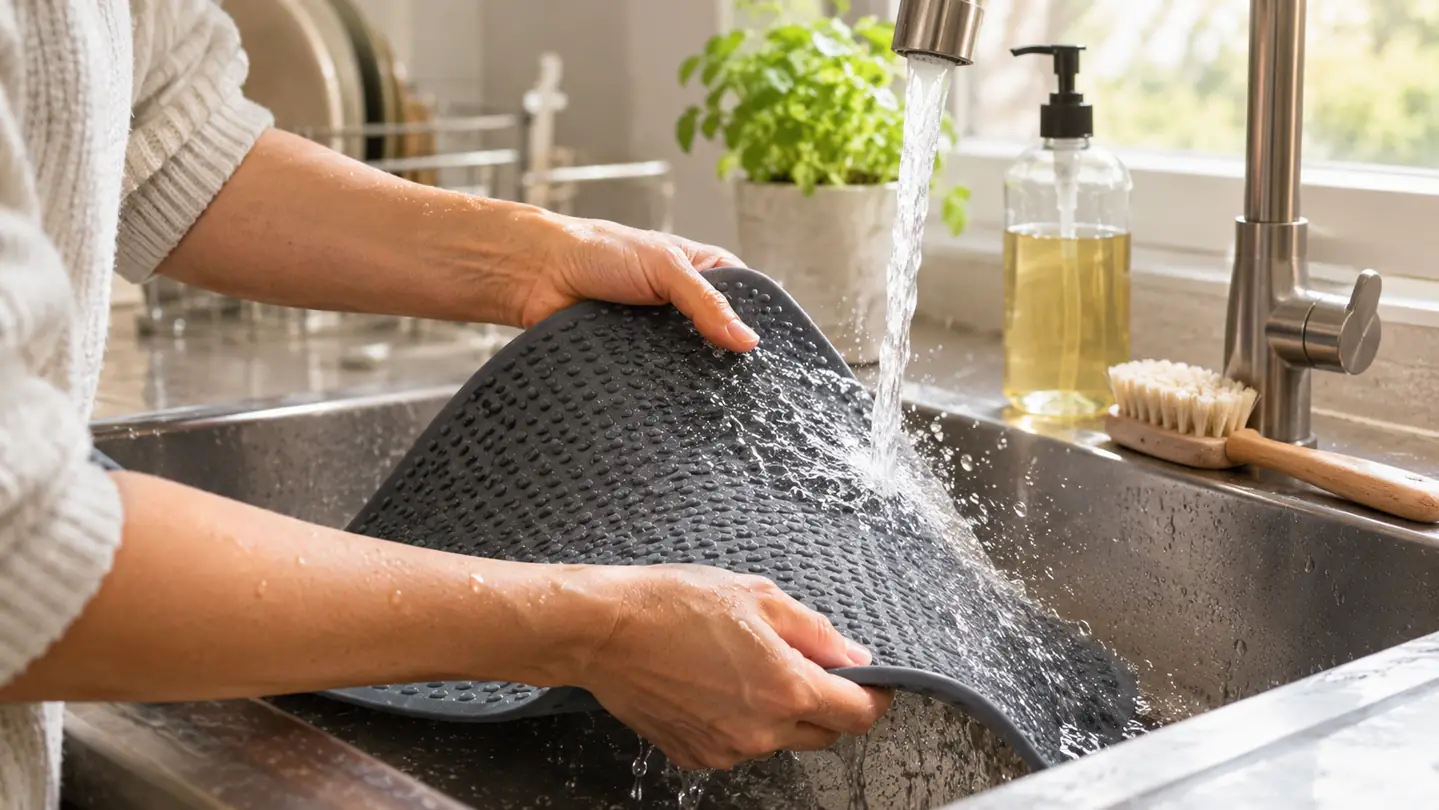
Hand washing a heavily textured LickiMat is not the same as rinsing a cereal bowl. Wet food and peanut butter settle into the pattern and a pass under the tap does nothing at all. What works for me is warm water, a drop of dish soap, and a soft dish brush worked in small circles over the whole surface, then a rinse and a stand to dry. It takes about four minutes, sometimes five if I let it sit first. If I try to shortcut it with my fingers, I find dried bits the next morning, and Moose finds them too.
The warning I would pass on is about soaking. I left one in the sink overnight in warm water once, and by morning the kitchen smelled like something had died behind the refrigerator. It had not. It was the mat. Since then it gets washed the moment he finishes and stands to dry on the rack, and the fact that the set includes two is the reason that routine actually holds. Not variety. Rotation.
How I Freeze It, and What I Would Do Differently
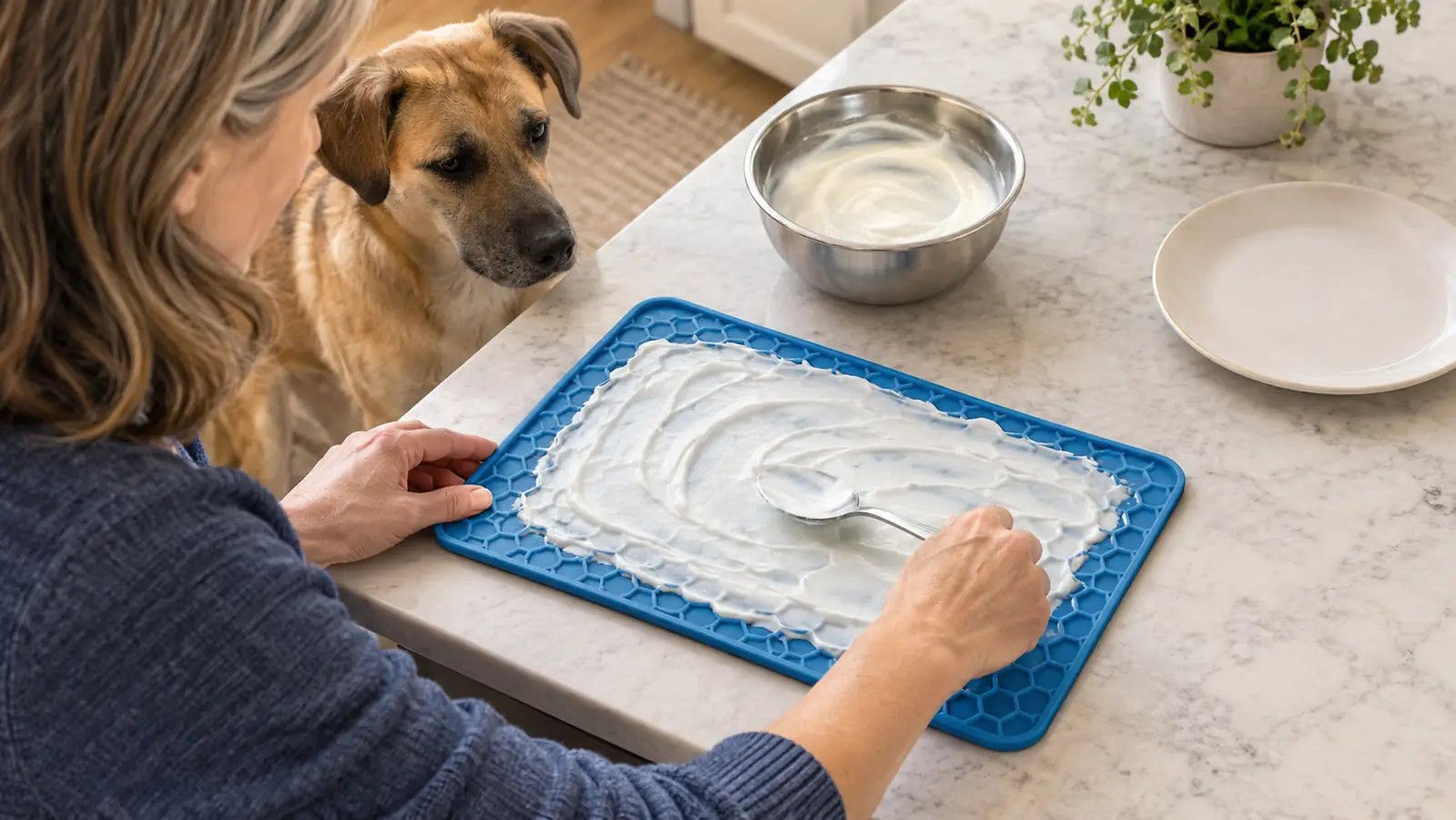
Freezing is what turned this from a nice idea into something I reach for most days. The method that works in my kitchen is thin and flat. One heaped spoon of plain yogurt, or two spoons of wet food, spread with the back of a spoon until it is nearly see through in places. Thick layers take much longer to freeze and Moose loses interest in the frozen outer edge before he ever reaches the middle. A thin layer freezes solid in two to three hours on a flat shelf, which means a mat put in after lunch is ready before supper.
Practical things I learned the stubborn way. Put the mat on a plate or a small tray before it goes into the freezer, because a loaded mat carried across a kitchen at an angle is a cleanup job waiting to happen. Do not stack a second mat on top of a wet one, no matter how much room you think you have. And do not freeze anything you would not want to scrape off a freezer shelf, because eventually some of it gets there. I keep both mats in rotation and freeze one most afternoons so there is a frozen one ready for the next morning's errand.
Does everyone need to freeze? No. At room temperature a mat with wet food on it occupies Moose for three or four minutes, which is still useful if all you want is a pause before you pick up your keys. Frozen stretches it to ten or twelve minutes in our house and turns it into something he waits for. In summer here, with the afternoon storms, frozen is the version that works, and it is the one I hand him when the thunder starts.
What to Spread on It, and What I Stopped Using
Plain yogurt, wet dog food, and a thin smear of peanut butter are the three that work for us. The vet tech who checked Moose the week he arrived gave me the one rule I still follow, which is to read the peanut butter label for xylitol, because it turns up in some of the sweetened ones and it is not safe for dogs. I buy the plain kind with one ingredient now. If you are unsure about any food for your dog, ask your vet, not a review on the internet, mine included.
What I stopped using was anything chunky. Chunks sit in the texture and will not freeze flat, and digging them out afterward is a miserable five minutes. I also stopped using a big dollop of peanut butter as a way to buy quiet, because it turned a ten minute mat into a four minute mat followed by a dog licking an empty mat and staring at me. Thin and even beats thick every time.
One habit I added later: I count it. Moose gets a mat instead of part of his breakfast rather than on top of it, because a spoon of yogurt plus wet food plus his full bowl is more than he needs, and he is a dog who eats until the bowl is empty no matter what is in it. He got a little soft around the middle in May and I cut the toppings back, which fixed it. If your dog has a sensitive stomach, allergies or a weight problem, that is a conversation for your vet, not for me.
Ten to twelve minutes of licking, most mornings, before I pick up my keys. That is the honest return on a mat, and in our house it was worth the drawer space.
How It Fits Our Day Now
On a normal weekday the mats come out twice. Once in the morning, frozen, while I put my shoes on and gather my keys, and once in the late afternoon when Moose gets what my husband calls his fussy hour and needs something to do that is not barking at the neighbor's cat through the fence. On storm days it is three times, and on nail trim day it is the only thing that gets us through. The rest of the time it lives in the drawer beside the dish brush and I do not think about it at all, which is the highest compliment I can pay a piece of dog gear.
Where It Fell Short in Our House
The mats did not teach Moose to be alone. I want to be plain about that, because part of me hoped they would. He still cried some mornings in the first months, and what actually helped was short practice absences, the crate, and time. The mat gave him something to do at the front end of the leaving routine so that the leaving itself was less of a shock. It smoothed an edge. It did not do the work.
It is also not a chew toy and I would not leave a dog alone with it. The listing describes the material as strong, and mine has held up to daily use since April with no tears or missing pieces, but a flat rubber mat is not built for a dog who likes to grab and shake. Mine gets picked up before I walk out the door, every single time, and lives in a drawer when it is not in use. If your dog destroys soft things, watch the first few sessions closely and put it away after.
The smaller complaints add up. Eight inches is small for a big dog and he finishes fast. On the tile it slides when he pushes it with his nose, so it lives on the rug or I hold a corner with my foot. The deep texture takes real effort to clean. And it holds a smell if you forget one, which I did once and will not do again. None of those are deal breakers. They are the reasons I would not call it effortless.
About That Slow Feeder Label
The listing calls these slow feeders, and I understand the reasoning. The licking does slow a dog down compared to a bowl he can inhale. But I would describe it as a pause button rather than a meal. Moose is a gulper. His kibble still goes in a bowl, and the mat is what he gets after, or instead of a snack, or while I trim his nails. If a dog is bolting his food and you are worried about it, a mat with a thin layer of wet food is not the same tool as a bowl designed to slow him down, and I would ask your vet about the bolting rather than assume a mat solves it.
What I Liked
- Has held up to daily use since April with no tears or missing pieces
- Two mats means one is always clean and dry while the other is in use
- A thin layer freezes solid in two to three hours on a flat shelf
- Eight inches square fits in a kitchen drawer and takes about four minutes to hand wash
- Fits into our leaving routine, storms and nail trims without any fuss
Where It Falls Short
- The care line says hand wash only while a listing bullet says dishwasher safe
- Small for a large dog, so Moose is finished in ten to twelve minutes
- The deep texture traps food if you skip the brush
- Slides on tile, so it lives on the rug in our house
- Not a chew toy, so it has to be picked up after every single use
Who This Is For
If you have a food motivated dog who needs a job for ten minutes, the LickiMat two-pack earns its space. In our house that is the ten minutes before I leave on an errand, the worst part of a summer storm, nail trims, and the moment the doorbell rings when I want Moose on his bed instead of launching himself at the door. It is small enough to keep in a drawer, it washes in the sink, and the two mat rotation is the version that actually works. It also suits people who read labels and want to know the care instructions before buying rather than afterward.
It is a good fit for a household with one dog and a person who is home enough to wash a mat most days. That is the honest requirement. Not a big one, but a real one.
Who Should Skip It
Skip it if you are hoping it will fix something. If your dog is showing aggression, guarding, bite behavior, or anxiety that is not improving, a mat is not the answer and neither is this review. Talk to your vet or a certified trainer, and do that first. I am a retired dental office manager with one dog and about eight months of notes. That is all I am.
Skip it too if your dog swallows things whole, if you know you will not hand wash a textured surface every day, or if your dog is on a strict diet and you cannot spare the calories for toppings. There is no point in buying a mat that turns every afternoon into an argument about food.
What I Would Tell a Friend Who Just Adopted
I would tell her to buy the two-pack, freeze one thin layer at a time, wash it the minute the dog is done, and expect ten minutes rather than an hour. I would tell her not to buy it as a fix for crying at the door, and to read the peanut butter label before she spreads anything. I would tell her the same thing I tell myself most weeks, which is that the mat is a small tool that makes a hard moment easier, and if it makes a new dog's afternoon a little calmer while you teach him what you actually want, that counts for something in a house that is still figuring itself out.
If you try one thing this week, try a frozen mat
Thin layer, flat shelf, two to three hours. That is the version that bought me a quiet exit on errand mornings, and the version I would hand a friend first.
Amazon See the LickiMat Two-Pack on Amazon →