
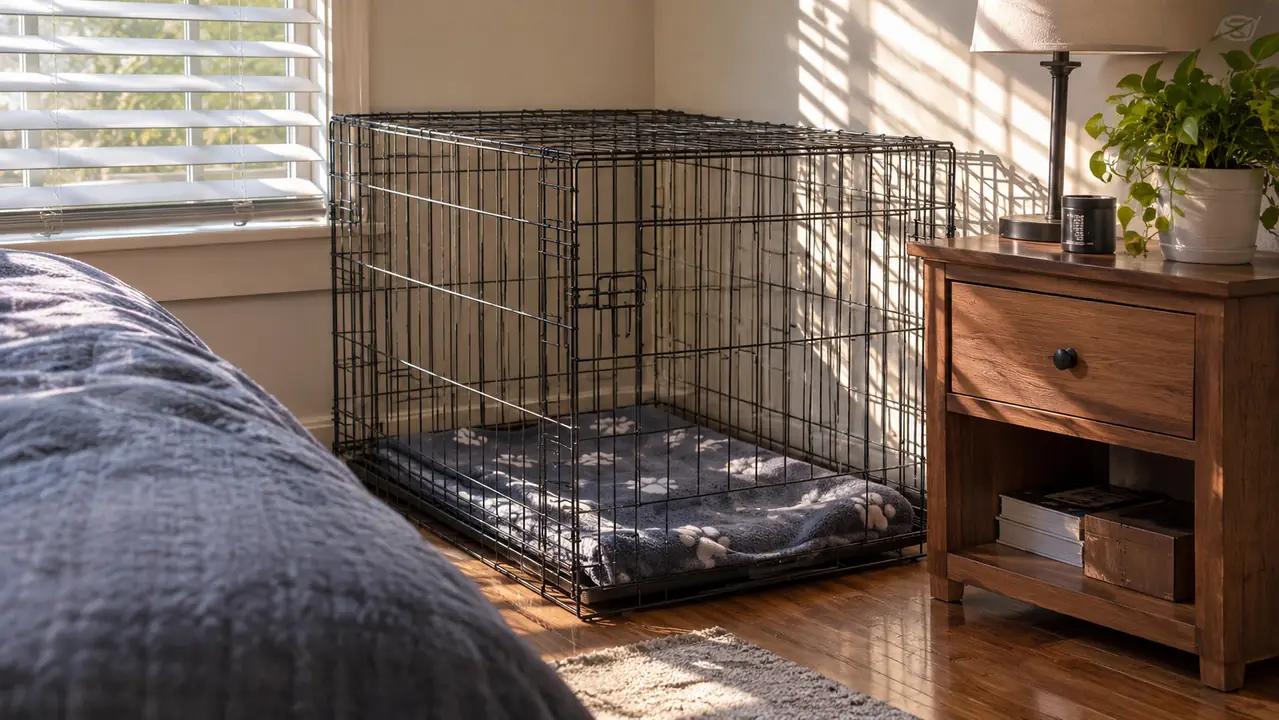
Moose came home on a Tuesday in early March 2026, four months old and all legs, forty minutes after I signed the last paper at the shelter. He walked into our house in Myrtle Beach, sniffed every baseboard in the hallway, and threw up on the kitchen tile. The crate was already standing in the corner of our bedroom next to my side of the bed. I had bought it a week earlier, on the advice of a shelter volunteer who had listened to me ask the same question three times: the MidWest Homes for Pets 36-inch single door iCrate. I am not a trainer. I am fifty-seven, retired from a dental office, and until this dog I had not raised a puppy since I was a kid living outside Pittsburgh.
What I wanted was modest. A place where a nervous rescue puppy could not chew the furniture, and a place where he would sleep at night instead of pacing the hallway and whining at the front door. What I got, after about ten noisy nights, was better than that. He is a year old now, roughly forty-five pounds, and most nights he walks into that crate on his own around nine o'clock and puts himself to bed. The door stays open all day. He goes in for naps. This is what I would tell a friend who just adopted a shelter puppy and is standing in a store aisle staring at crates.
The Quick Verdict
Ten rough nights, then eleven months of a dog who walks in on his own. The divider panel is the reason the same crate fit a four-month-old in March and a forty-five pound yearling in November.
Amazon Check Today's Price →The crate he cried in for ten nights, then started choosing on his own
36 inches long, 23 wide, 25 tall, with a divider panel that let me shrink it for a four-month-old and slide it back as he grew. Tool-free assembly, folds flat, removable tray.
Amazon Check Today's Price on Amazon →How I've Used It
I bought the 36-inch size in late February 2026, a week before Moose came home, because the listing puts it at 41 to 70 pounds and the shelter guessed he would land somewhere in the fifties. He was nowhere near that in March. That is what the divider panel is for. I set the panel about a third of the way in, giving him a space roughly the size of the bed he would actually curl up in, and slid it back a notch every few weeks as his legs got longer. By June he was filling the thing and I pulled the divider out completely. It has been out ever since.
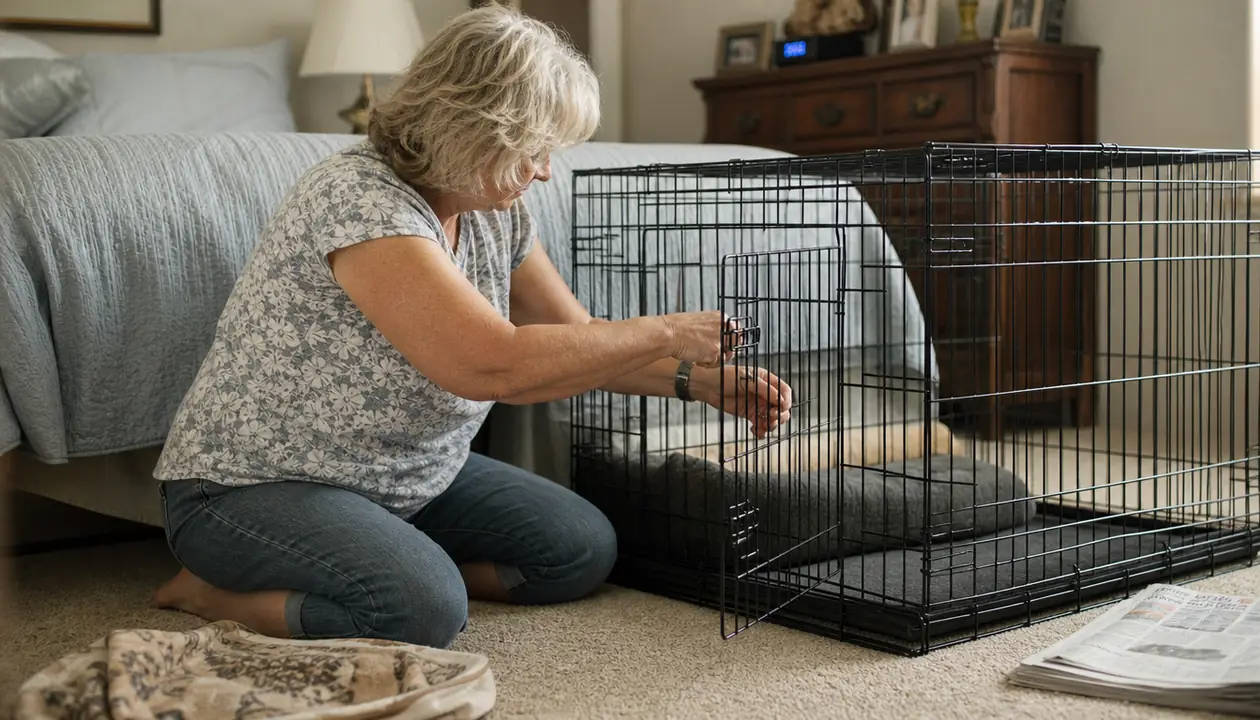
Those first few adjustments were not elegant. I remember the second Sunday in March getting down on the carpet with the panel in one hand, my reading glasses in the other, trying to work out which of the wire slots lined up on both sides at once. The panel has to drop into matching slots on the two long walls, and if you are off by one rung on one side, it sits crooked and the whole thing looks wrong. It took me maybe eight minutes the first time and about thirty seconds every time after that, because once I understood the slot pattern my hands knew it. I moved that panel five times between March and June. Five moves, one crate, no second purchase.
Day to day, the crate sits in the same corner of the bedroom and does not move. He sleeps in it every night. During the day the door is open and he wanders in and out, usually after a walk when he is wet and I want him off the bed for twenty minutes. When I run an errand I put a frozen stuffed rubber toy in with him, close the door, and leave. The longest he has been in it alone is about two hours. It is not a place he gets sent to when he is bad, because I did not want it to become that.
I assembled it myself in the living room in under fifteen minutes with no tools, which mattered more than I expected, because Gary was at the hardware store and I am not a person who reads diagrams well. It came folded. It unfolds. The whole thing weighs 22 pounds, and the handle on top means I can move it from room to room if I need to, though I mostly do not.

The Divider Panel Is the Whole Reason This Worked
Here is the mistake I nearly made. A 36-inch crate is a lot of empty floor for a twenty pound puppy. Drop a four-month-old into the full footprint and he has room to pace, room to pee in one corner and sleep in another, and no reason to feel settled, because a den the size of a tennis court is not a den. Every handout the shelter gave me said some version of this and I did not fully believe it until I watched him circle that big space the first night, whining at the wire.
So the next morning I slid the divider in and gave him a slice of the crate about the size of a laundry basket, with his fleece blanket folded in it and just enough room to stand up and turn around. He complained anyway. But he stopped circling. By the third night he was lying down within a few minutes of going in. As he grew I moved the panel back, and back again, and the crate grew with him without me buying a second one. That is the honest case for the MidWest Homes for Pets divider: it turns one purchase into three sizes.
There was one week in April when I second-guessed the whole setup. He had a growth spurt, and the space that had been cozy in March was suddenly too tight, and I did not notice for four days. He paced. He nudged the blanket into a pile. On the fifth morning I measured him against the panel with my hand and realized I had left him with barely enough room to turn around, which is the line every guide tells you not to cross. I moved the panel back that afternoon and he went in that night without a sound. The lesson was mine, not the crate's: check the fit once a month, not once when you think of it.
If you take nothing else from this, take that. The divider is not an accessory. It is the feature. A crate without one is a crate you will either replace in four months or use wrong for four months.
The First Ten Nights, Honestly
He cried. Not the whole night, but enough. Roughly ten nights of it, starting around eleven and tapering off by two, and then one night he just did not, and that was that. I want to be careful here, because I am not a behaviorist and I am not going to tell you what your dog will do. This is only what happened in our house.
What I did was keep the crate next to my side of the bed so I could hang a hand down beside it, keep the trips outside boring and businesslike, and put him back in afterward with no conversation. What I did not do was take him out to comfort him, because I was afraid of teaching him that crying opened the door. Whether that was the right call or just the call I made, I cannot say. Around night eleven the crying stopped and he started walking in on his own at bedtime, and I have not had a bad night since. If your puppy is still distressed after several weeks, or if the crying escalates rather than fades, that is a conversation for your vet or a certified trainer, not for a blog post.
What I would do differently is keep a note. I did not, and by the second week I could not have told you honestly whether the crying had gotten shorter or whether I had just gotten more tired. Somewhere in my kitchen junk drawer there is a grocery list from that March with a column of times scribbled on the back, because on night six I started writing down when he started and when he stopped, and that scribble is the only reason I know the number was about ten nights instead of, say, twenty. If you are in the middle of it, write it down. The days blur and the progress is too slow to feel.
Living With It: Tray, Feet, Handle, Folds Flat
The tray slides out from underneath without taking the crate apart, and I wash it in the kitchen sink about once a week, more when he was small. It has a lip on it, and I have never had anything run off the edge onto the carpet. The listing calls it leak-proof. Mine has held up to one puppy accident and a spilled water bowl and come out the other side fine.
The rubber feet do more work than they sound like they do. Before I noticed them, I had the crate on the hardwood in the living room for two days and it walked a few inches every time he turned around in it. On the carpet in the bedroom it does not move at all. The frame is metal and it is stiff, not flimsy, and the door latch has not popped open once in eleven months, including the month he decided the crate was a digging pit. That digging phase lasted most of July. He would get in, brace his front feet, and push the blanket into the front corner with his nose, then scrape at the wire floor for a while before settling. The tray underneath caught everything. The frame did not bend, the door did not spring, and when he was done the crate still folded the way it had on day one.
It folds flat, which I have used exactly once, when we moved a dresser through the bedroom. The rest of the time it stays up. The 36 by 23 by 25 inch footprint fits neatly in the corner without crowding the walkway to my side of the bed, which was the reason I did not go bigger. Gary measured the gap between the nightstand and the wall before I ordered and told me I had about forty inches to work with. I have about three to spare.
Where It Falls Short
It rattles. When he shifts his weight at two in the morning, the wire shifts with him and it makes a sound. Not loud, but in a quiet house at two in the morning, you hear it. I draped a light sheet over the top and two sides for the first month to deaden it and to make the space feel more like a den, and it did help, and I took it off once he stopped needing it. If you try that, make sure the sheet cannot be pulled inside and chewed.
The floor is bare metal. The tray sits underneath it, and there is no padding included. You will want a blanket or a bed. Moose has a fleece blanket in there and he rearranges it every single night before he lies down, which is either charming or a sign that the floor underneath is not comfortable, and I suspect it is both.
And a wire crate is a wire crate. It does not hide the dog, it does not mute sound, and it does not look like furniture. Mine is in the bedroom where nobody sees it but us. If your crate has to live in the middle of your living room and you care how that looks, this is not the crate that solves that problem.
What I Liked
- The divider panel let one crate fit a four-month-old and a forty-five pound yearling
- Tool-free assembly out of the box, under fifteen minutes with no tools
- Tray slides out for washing without disassembling anything
- Rubber feet keep it from sliding on carpet
- Folds flat and has a carry handle for the one time a year you move it
- Door latch has stayed shut through eleven months of a dog who digs
Where It Falls Short
- The wire rattles when the dog shifts at night
- Bare metal floor, so you have to add your own bedding
- Heavy and awkward at 22 pounds if you plan to move it often
- No cover included, and it looks like a wire crate in your bedroom
- The first ten nights were loud and nothing about the crate prevented that
Ten nights of crying, then a dog who walks into the crate at nine o'clock on his own and puts himself to bed. That is the whole review, really.
Who This Is For
This is for the person who just brought home a puppy they cannot yet predict the adult size of. If you are guessing between fifty and seventy pounds, the 36-inch MidWest Homes for Pets crate with the divider gives you room to be wrong in either direction for a few months, which is more than most crates offer. It is also for anyone crate training in a bedroom or a quiet corner rather than a main living space, and for anyone who wants to assemble the thing alone, in the evening, without hunting for a screwdriver.
It suits a dog who is nervous but food motivated and will settle with a frozen toy, which is what Moose turned out to be. It suits a household that is home most of the day, since the door being open most of the time is doing half the work of making the crate feel like a normal place to be. It also suits a house with carpet in the room where the crate will live. That sounds like a small thing. It is not, if your dog turns out to be a digger.
Who Should Skip It
Skip it if your dog is already near or past seventy pounds, because the listing tops this size out around there and you would be buying the wrong crate twice. Skip it if you need something you can carry up and down stairs easily, because 22 pounds of metal with a handle is still 22 pounds of metal. Skip it if the crate has to sit in the middle of your living room and you want it to look like a piece of furniture. And skip it if your dog has real confinement anxiety, meaning genuine panic rather than a puppy complaining. That is not a crate problem, and no crate on a listing page solves it. Talk to your vet or a certified trainer about that one.
One more thing, and this is the part I would say at my kitchen table rather than in a review. The crate did not train my dog. The routine did. Same bedtime, same boring potty trips, same frozen toy when I left, and the crate was just the room all of that happened in. If you buy this crate and skip the routine, you will have bought a wire box.
One crate that grew from twenty pounds to forty-five without a second purchase
The divider panel is the part that matters. Set it small for a new puppy, slide it back as the dog fills out, pull it out when you are done. Tool-free assembly, removable tray, folds flat.
Amazon Check Today's Price on Amazon →