
The week before Moose came home, I stood in my kitchen with a tape measure and a scrap of paper, trying to work out how much floor space I was about to give up. He was four months old then, a shepherd and hound mix the shelter guessed would land somewhere near fifty pounds, and I had no gear at all. I am 57 and this is the first dog I have trained myself. Growing up outside Pittsburgh we always had family dogs, but my mother handled the feeding and the messes. So I did what I always do and read labels and listings until my eyes crossed. The two finalists were a folding metal crate and one of those soft fabric crates that look like a small tent. I bought the MidWest Homes for Pets 36-inch single door iCrate, and I have now lived with it for about eight months. Here is the honest comparison, including the parts where the tent wins.
The short answer: if you are bringing home a puppy who is still learning to hold his bladder and still putting his mouth on everything, the MidWest iCrate is the safer first buy. If you already have an adult dog who settles in a crate and you want something for weekends away and the back of the car, a soft-sided crate is lighter, quicker, and easier on your shins.
| MidWest iCrate | Soft-sided crate | |
|---|---|---|
| Construction | Folding metal frame with a slide-out tray, rubber feet, and a carry handle | Fabric panels stretched over a flexible frame with mesh windows and zippered openings |
| Chew resistance | Metal bars and a latching door, with nothing on it to shred | Fabric and zippers, which a mouthy puppy will test |
| Containment | Rigid sides keep their shape when a dog leans or paws at the door | Flexes and shifts when a dog pushes against it |
| Room to grow | Divider panel makes it puppy sized, then slides back as the dog grows | One fixed size, so a growing puppy means buying the next one up |
| Travel and car trips | Folds flat and has a handle, but it weighs 22 pounds | Light enough to carry like a duffel and sets up in seconds |
| Moving it around the house | Stays exactly where you put it | Easy to pick up and shift from room to room |
| Cleaning | Tray lifts out and wipes clean in the sink | Spot clean the fabric in place |
| Settling at night | Enclosed metal box in a corner, quiet on its rubber feet | Softer edges, but a puppy can paw it across a hard floor |
| View out for the dog | Bars on every side, so the dog can see the room | Mesh panels give a wider view and more airflow |
| Warranty | The listing states a one-year manufacturer warranty | Set by whichever maker you buy, so read that listing closely |
| Best for | Puppies, chewers, and a permanent indoor spot | Adult dogs who already settle, and weekends away |
What the MidWest Homes for Pets iCrate Actually Is
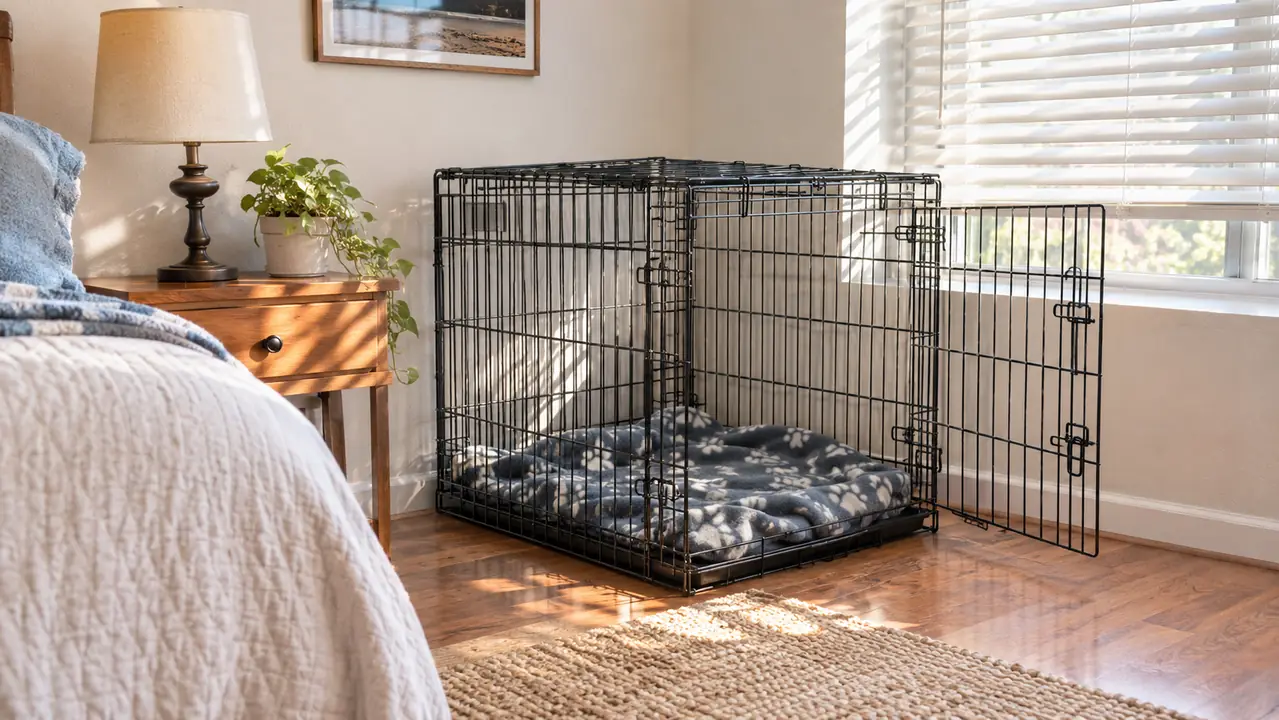
The listing gives the outside measurements as 36.5 by 23.25 by 24.75 inches, the crate itself weighs 22 pounds, and the bar spacing is listed at 37.5 millimeters. It is metal, it folds, and the listing says it goes together without tools. Mine did. It came out of the box flat, I unfolded it on the bedroom floor, and I had it standing before Gary got back from the store. The door has a latch the listing calls lockable, there are rubber feet on the bottom, a carry handle on top, a tray that slides out for cleaning, and a one-year manufacturer warranty. Nothing about it is fancy. It looks like what it is, a metal box with a door, and I mean that as a compliment.
The part I did not appreciate until I used it is the divider panel. Moose came home at about four months and maybe twenty-five pounds, and a 36-inch crate would have been a cavern to him. I set the divider so he had a space roughly the size of a dog bed, with the fleece blanket laid on the tray. As he grew I moved the divider back a few inches at a time. It came out completely in June, when he was close to his adult size. That is the whole reason I bought a crate sized for the dog he would become instead of the puppy he was, and it is the single feature I would not give up.
Where the MidWest iCrate Wins
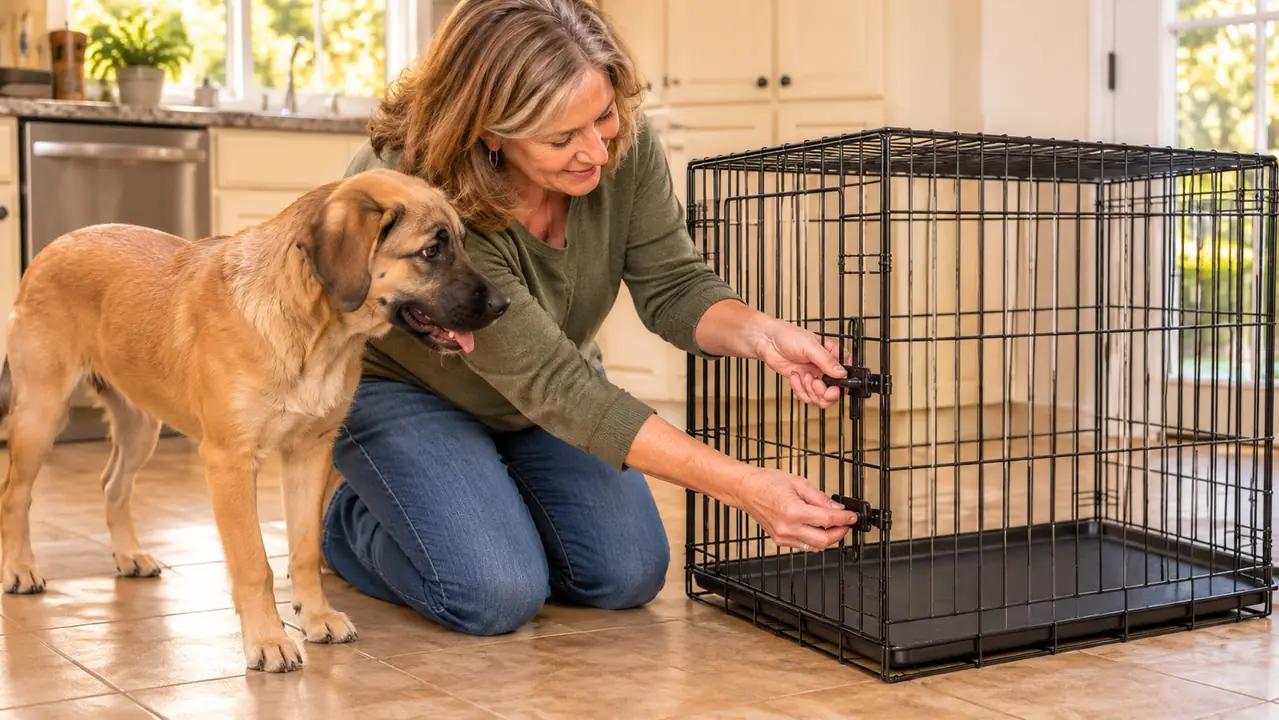
Containment, plain and simple. A soft-sided crate is only as strong as its zipper, and a puppy in the mouthy stage is a small machine for finding zippers. Moose was teething when he came home and he was not gentle with anything. The metal bars did not care. He pawed at the door that first week, the latch held, and the frame never flexed. In a fabric crate, that same pawing puts the load on seams and mesh. I have watched a dog in our Tuesday puppy class push one until the whole thing walked across the floor. The woman who owns it likes it fine for her adult dog at a hotel. For a puppy, though, I would be checking that zipper every single night before bed.
The second win is the tray and the divider working together, which is really a win for house training. Puppies have accidents. Mine had several. With the metal crate, the tray slides out, I wiped it in the bathroom sink with dish soap, and the crate was back together before Moose noticed I had taken anything. The divider kept his sleeping space small enough that he did not want to soil it, which is the idea behind crate training as I understand it from the shelter handout. And the rubber feet mean the crate stays put. It sits in the corner of the bedroom next to my side of the bed and it has not moved an inch since February.
He cried for about ten nights. Then he started walking into the crate on his own at bedtime, and I stopped feeling like the worst person in South Carolina.
Where a Soft-Sided Crate Wins
Travel, no contest. If you are driving to see family or staying in a rented place at the beach, you do not want to wrestle a 22-pound metal crate through a door and set it up twice. A soft-sided crate folds like a duffel, weighs almost nothing, and pops open in the time it takes to unzip it. When Moose is older and steadier, that is the one I would take in the car. I also like that mesh panels let more air through and give the dog a wider view than bars do. Some dogs find that calming. With Moose, at this age, it would be exciting, which is exactly what I am trying to avoid at bedtime.
The other soft-sided advantage is that it is gentler on the person. I have walked into the metal crate with my hip in the dark more than once, and I have the bruise to show for it. Fabric gives. It is also easier to move from room to room, easier to tuck into a corner, and easier to store when it is not in use. If you have a small house, or you only crate a dog occasionally, that matters more than bar strength. Do not let anyone tell you a fabric crate is a lesser purchase. It is a different tool for a different dog.
What it is not good at is holding a determined puppy. The fabric gives under a paw, the zipper is within reach, and the whole crate slides on a hard floor. That is not a knock on the crate. It is a knock on using it for a dog who is still in the phase where everything looks like a chew toy, including the walls of his bedroom.
The crate that survived Moose's teething months
The 36-inch single door iCrate from MidWest Homes for Pets, with the divider panel that made it puppy sized in March and full sized by June. It is the crate in my bedroom corner and the one I still point friends toward.
Amazon Check Today's Price on Amazon →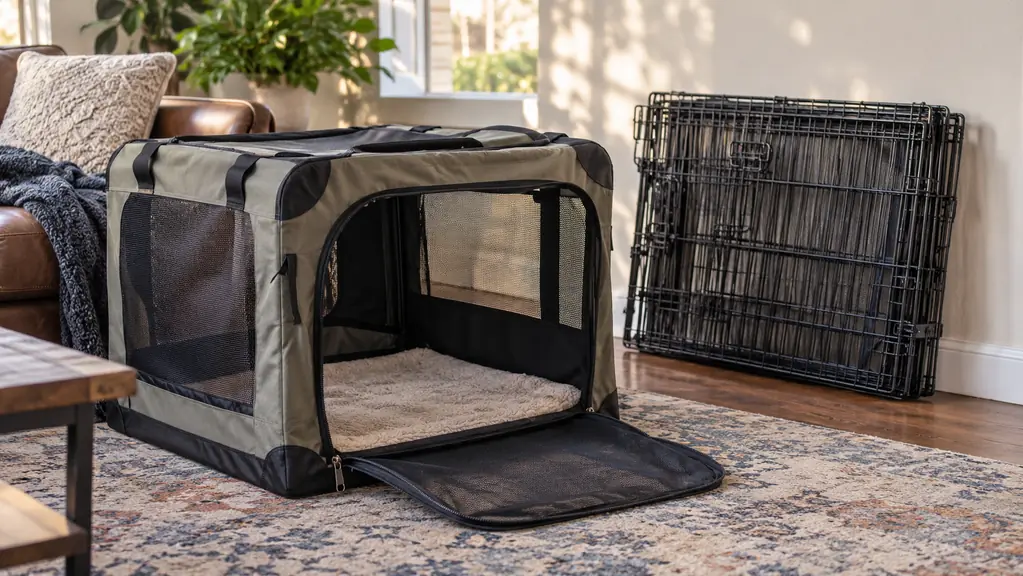
The First Ten Nights in the Bedroom Corner
The first night Moose cried. So did I, a little, standing in the hallway in my robe at two in the morning. The second night was worse. I had read enough to know I should not let him out for the crying, because that teaches him that crying opens the door, but knowing a thing and doing it at two in the morning are two different skills. What helped was putting the crate where he could see me. It sits next to my side of the bed, not out in the laundry room, and once he could see that I was still there he settled faster. The fleece blanket smelled like the house. I also started his last trip outside later than I thought was necessary, which cut down on the middle of the night wake ups.
It took about ten nights. Then one evening he walked into the crate on his own while I was folding laundry, turned around twice, and lay down. I stood in the doorway and did not say a word. Now, at about a year old and 45 pounds, he sleeps in it every night and the door stays open during the day. He goes in for naps on his own. I use it when I run errands, with the door latched and a frozen stuffed KONG, and he is usually asleep before I reach the driveway. That is not a brag about my training. It is what happened in our house with this crate, and I know plenty of dogs who never took to one at all.
What I Liked
- All metal, so a mouthy puppy has nothing to shred
- The divider panel made it usable at four months and still usable at a year
- The tray slides out and wipes clean in the sink
- Rubber feet keep it in one place on a hard floor
- Folds flat and goes together without tools
- The listing states a one-year manufacturer warranty
Where It Falls Short
- It weighs 22 pounds, so it is not the crate I would carry to a hotel
- It is a metal box in your bedroom and it looks like one
- The bars are hard on a hip in the dark
- A puppy can still cry in it for the first week or two, and no crate fixes that
- The listing gives indoor use only
The Mistake I Nearly Made
I nearly bought the soft-sided crate because it was lighter and I could picture myself carrying it to the car with one hand. That picture was true and it was also beside the point. I was not buying for the car. I was buying for a puppy I had met exactly once at the shelter, who had already chewed through the corner of a cardboard box in the meet and greet room. The other near miss was size. I had the 30-inch version in my cart for two days because it looked tidier, and a friend who has had big dogs her whole life asked me one question: what does he weigh going to be at a year? I swapped to the 36-inch and used the divider instead. Best twenty minutes of reading I did all February.
So my advice on picking is to measure twice and measure the dog at his adult size, not his puppy size. Measure the corner where the crate will live. Measure the widest door in your house, because a 36-inch crate has to get through it. Then decide which kind of crate matches the dog in front of you, not the dog you hope he becomes by summer. A soft-sided crate bought too early is money sitting in a closet. A metal crate bought too small is a dog who cannot turn around.
Who Should Buy Which
Buy the MidWest iCrate if you are bringing home a puppy, if your dog is a chewer, if you want one crate that lasts from four months to adult size, or if the crate is going to live in one room and stay there. The divider, the slide-out tray, and the rubber feet are the reasons it worked in our house, and the listing backs all three of those up. Buy a soft-sided crate if your dog is already crate trained and settles on his own, if you travel more than a few times a year, or if you need something that folds into a duffel and lives in a closet between trips. What I would not do is put a soft-sided crate in front of an untested puppy and hope.
One more thing, and I mean it. If your dog panics in a crate, hurts himself trying to get out, drools, paces, or cannot settle at all, that is not a problem I can solve with a purchase and it is not something to push through. Call your vet and a certified trainer. I am not a trainer, a behaviorist, or a vet, and I would not pretend to be one. Everything here is a retired dental office manager in Myrtle Beach telling you what happened in her house with one rescue puppy and one crate.
Start with the metal crate. Move to the soft one when the chewing stops.
The 36-inch single door iCrate from MidWest Homes for Pets, with the divider panel, the removable tray, and the rubber feet that keep it in the corner where you put it.
Amazon Check Today's Price on Amazon →