
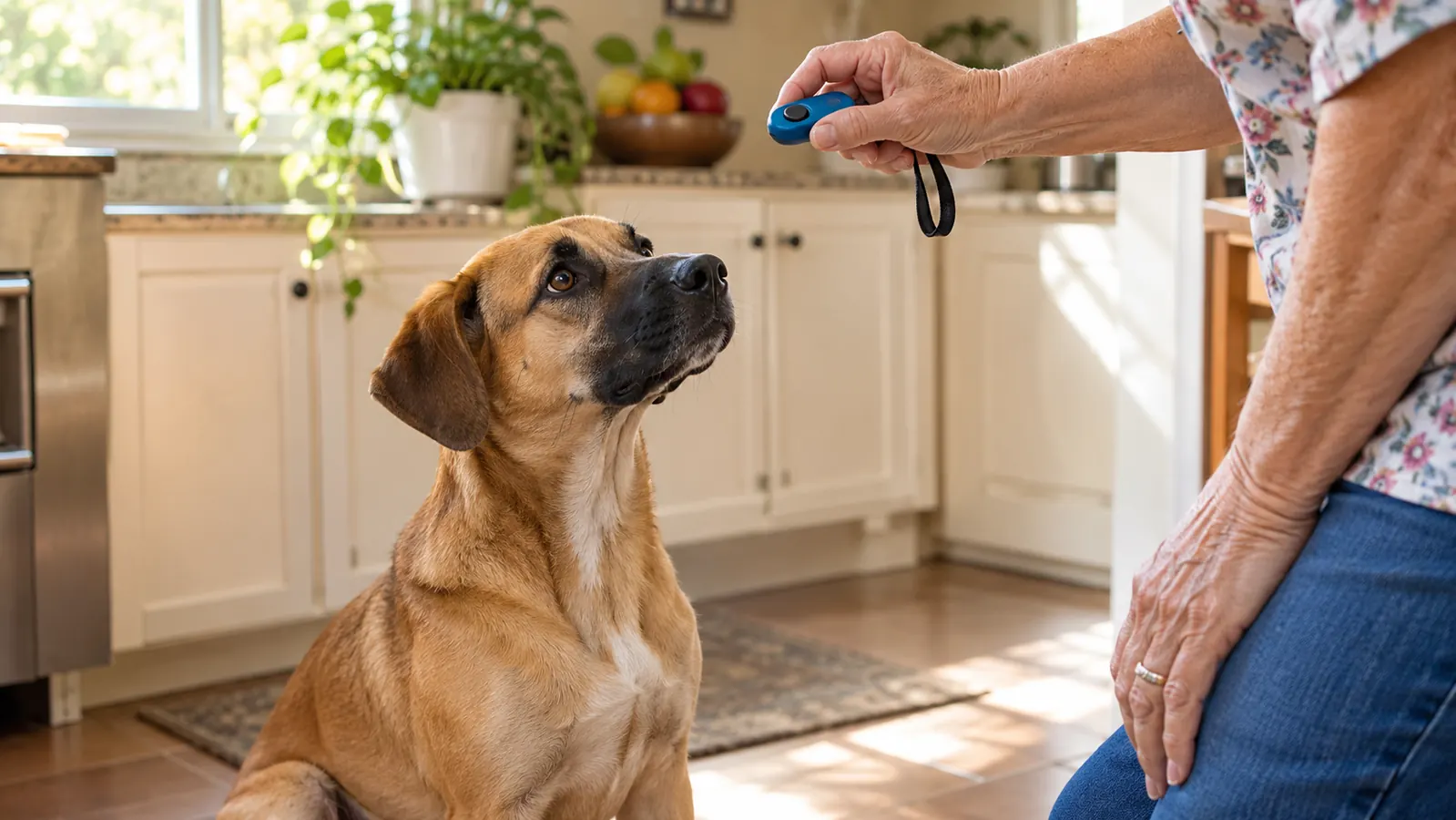
The first thing I bought for Moose after the crate was a clicker. Not a fancy one, not a bundle with a book and a treat pouch, just the Starmark Pro-Training Clicker that a shelter volunteer mentioned in passing while I was signing paperwork. I remember nodding like I understood. I did not. I had grown up with family dogs, but I had never trained one myself, and I was fifty-seven years old, newly retired, newly moved to South Carolina, and standing in my kitchen with a four-month-old mixed breed puppy who thought the table leg was a chew toy.
Eight months later, that same Starmark clicker is hanging on a hook by my back door next to the leash. The lettering on the side has worn a little where my thumb sits. I have used it for sit, for down, for four paws on the floor when guests knock, and for a dozen smaller things I did not plan. It was the least expensive piece of gear I bought him that month and it has done more for my relationship with this dog than anything else in the house. It has also been frustrating in ways nobody warned me about, and I want to be straight with you about both sides before you decide whether it belongs in your pocket.
The Quick Verdict
A cheap, sturdy, genuinely useful marker for reward-based training. It will not train your dog. You still have to do the timing, and the timing is the hard part.
Amazon Check Today's Price →The one piece of gear I still reach for eight months in
It is small, it clicks the same way every time, and mine has survived being dropped on a tile floor more times than I want to admit. If you are starting from zero like I was, this is the least expensive way to begin.
Amazon Check Today's Price on Amazon →How I've Used It
I bought it in late March 2026, about three weeks after Moose came home. He was around four months old, all legs and floppy ears, weighing maybe twenty pounds and heading toward forty-five. The shelter volunteer had said clicker training was good for nervous dogs because it lets you reward quietly instead of looming over them with a big voice. Moose was nervous about new people and loud noises, so that sounded right to me.
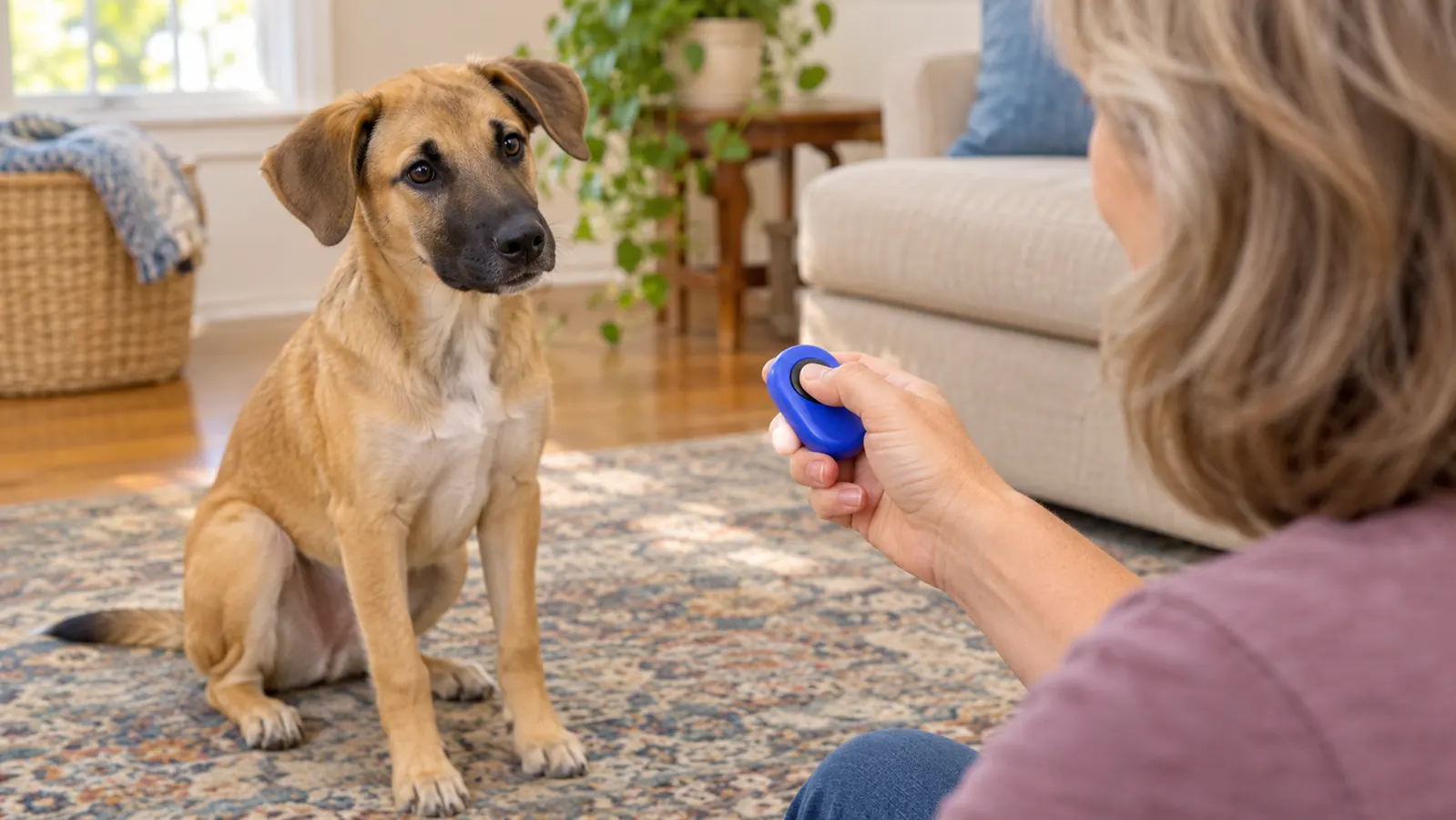
Here is how it actually worked in my house with the Starmark clicker. I would stand in the kitchen with a handful of tiny treats in my left hand and the clicker in my right. I would wait. He would eventually sit, because puppies sit constantly for no reason, and the instant his rear hit the floor I clicked and then treated. Click, then treat, every single time, in that order. That order is the whole thing. The click is not a command and it is not praise. It is a marker that says yes, that exact thing, right then, and the treat is coming.
We did five minutes at a time, maybe twice a day at first. I want to be honest: my first week was mostly wrong. I clicked after I reached for the treat, which meant I was marking my own hand movement instead of his sit. I clicked at the wrong moment so often that Gary, who was watching from the couch, started calling out that I was too late again, from across the room. Puppies are forgiving of a slow human, thankfully. By the second week I had my rhythm.
The real work came in April, when I decided the jumping on guests had to stop. My answer was not to yell at him or push him down. It was to mark the thing I wanted, which was all four paws down. Every time someone came to the door, I would have them wait outside while I clicked and treated any moment where all four feet were on the floor. If he jumped, the clicking stopped and the treats stopped and the person turned away. It was slow and it was boring and it made me feel like a doorman at a hotel, but by June we had something that looked like manners. He is not perfect. He still gets excited when the doorbell rings. But he now sits before I open the door most of the time, and the difference between April and June was like two different dogs.
Since then I use it a few short sessions a week for whatever new thing comes up. Hand targeting. Waiting at the back door before we go out. Going to his bed while I am fixing dinner. He hears the click and his ears come up and his whole body turns toward me, which is a nice feeling when you are a retired lady who is used to being ignored.
What the Clicker Actually Is
The Starmark Pro-Training Clicker is a simple object, so let me describe it the way I would describe it to a friend. It is a small handheld plastic clicker, and the listing gives the dimensions as 0.8 x 1.5 x 2.3 inches and the item weight as 0.4 ounces, about eleven grams. It fits in the palm of my hand, and I have small hands. You press the raised pad with your thumb and the metal element inside makes a sharp, consistent click. The listing says the clicker element is stainless steel and will not rust, and I can tell you that mine lives by a door in coastal South Carolina humidity and it still clicks cleanly.
It is water resistant rather than waterproof, so I would not drop it in the ocean on our beach access walks. It is listed as lightweight and portable, which sounds like filler until you consider the alternative. I tried a slightly bigger clicker a neighbor lent me for a week and I could feel it in my pocket. This one I forget I am carrying. The Starmark listing also mentions that it attaches to a keychain, and while I have not used that feature, I understand why people do. Mine is on a hook, but if you keep your keys by the door, that would keep it with you.
The listing also lists things like breed recommendation all breeds, dog breed size all, and pet type dog. That is the listing being thorough rather than telling you anything you did not know. The recommended uses listed are brain game, mental health and training, which is a slightly odd grouping on a product page, but the training part is what matters. It is listed as unscented and does not have any smell to speak of, which I appreciate because I keep treats in the same pocket. The listing also mentions an ergonomic design that fits comfortably in the hand, and after eight months of daily use I would say that holds up, though my thumb pad is the only thing that has any opinion about it.
How It Held Up Over Eight Months
I have dropped this thing on tile, on the driveway, and once into the grass while chasing a puppy who had stolen a sock. It still clicks. The metal element still has that same crisp sound, and the sound has not changed, which is the important part. A marker that starts to sound different or starts to miss is worse than useless, because you will be marking the wrong moments without knowing it.
The one thing that has changed is cosmetic. The click has worn where my thumb presses, so the surface is smoother and slightly shinier than it was in March. That is eight months of daily handling, and I do not think it means anything. Nothing has cracked, nothing rattles, and the pad has not loosened.
I keep my Starmark clicker on the same hook by the back door as the leash and harness, so it goes outside with us too. I have used it in the driveway for loose-leash work and at the beach access path in the early morning. Out there in the wind and the noise it is quieter than my voice, which is one of the reasons clicker training suits a nervous dog. A click is the same volume and the same tone every single time. My voice is not. When I am tired or annoyed my voice changes, and Moose can hear that. The clicker cannot have a bad mood.
I tried the treats first, then the yelling, then the ignoring. What finally moved the needle was a small plastic clicker that sounded exactly the same every single time.
The Part Nobody Tells You
The clicker is the easy half. The hard half is timing, and there is no product on earth that will do your timing for you. A marker has to land within about a second of the behavior, or you are teaching your dog something else entirely. Nobody explained this to me in a way that stuck until I had already made the mistake about forty times. I marked a lot of my own reaching and a lot of him breaking position before I understood.
The other thing I did not understand: the click does not mean sit. It means yes. In the beginning I was using it as a command, which made no sense and confused both of us. Once I understood that it is nothing but a marker, and that the reward follows every single click without exception, things got much easier. If you click, you pay. That sounds simple. I broke it a few times early on and paid for it in confusion.
Finally, and this is the part that made me put the clicker down for two weeks in May, there is a stage where your dog gets it and then appears to forget. That is not the clicker failing. That is how learning looks. I panicked and thought I had ruined him, then went back to shorter sessions and easier reps and he came right back. If you are the type to take a plateau personally, know that it is coming, because I did not know and it cost me two weeks of progress and a lot of sulking on the couch.

Clicker Training a Rescue Dog, Specifically
Moose came from a shelter in early March, and shelter dogs come with a history you do not get to read. He was nervous around new people at first, and he flinched at a dropped pan for a while. What the clicker gave me was a way to reward without touching him or looming over him. I could stand a few feet back, click, and toss a treat. That distance mattered for a dog who was not sure about hands yet.
It also gave me something to do instead of correcting. When he jumped on a guest, my instinct was to say no and push him off. Instead I had a plan: mark the good thing, pay the good thing, and let the bad thing be boring. That is not a fix and it did not happen overnight, but it is a way of thinking about a dog that I did not have in January and I do have now.
I want to be careful here. I am not a trainer. I am a retired dental office manager with a clicker and a lot of patience. If your dog has shown aggression, has bitten anyone, or has severe anxiety that keeps him from eating or settling, this clicker is not the answer and I would not pretend it is. That is a conversation with your vet or a certified trainer, and I would have that conversation before I bought anything.
What I Liked
- Clicks the same way every single time, which is the whole point
- Small enough to keep in a pocket or by the leash hook
- Stainless steel clicker element has not rusted in coastal humidity
- Lightweight at under half an ounce, easy to carry on walks
- Survived eight months of drops on tile, driveway and grass
Where It Falls Short
- It is a marker, not a trainer. Your timing does the work and mine was bad for a week
- The click is quiet, which is great outdoors but easy to miss in a noisy room
- No wrist strap with it, so I had to add a hook by the door to avoid losing it
- Nothing on the product itself tells you how to use it. You need outside guidance
Who This Is For
If you have just brought home a dog, especially a nervous one, and you are starting from zero the way I was, this is a sensible first purchase. It is small, it is durable, and it gives you a consistent sound to build every other behavior on. It is also a good fit if you have tried treats alone and felt like your dog was guessing. A marker like the Starmark clicker takes the guesswork out of the exact moment you are paying for.
It suits people who are willing to watch a few videos or read a short guide on marker timing before they start clicking. That is not optional in my experience. You cannot open the package and figure this out by instinct. If you are prepared to spend twenty minutes learning how a marker works, this is a very good tool for very little money.
Who Should Skip It
If you want something that trains the dog for you, skip it. It does nothing on its own. If you are already working with a trainer who uses a verbal marker and that is going well, you do not need to switch, and there is nothing magic about a click versus a well-timed yes. If your dog is sound sensitive or startled by sharp noises, a clicker may be a poor fit and worth testing carefully before you commit. And if you are dealing with aggression, biting, or serious fear, put the clicker down and call your vet or a certified trainer first.
I would also say skip it if you know yourself well enough to know you will not do five short sessions a week. There is no shame in that. A tool you do not use is just clutter on a hook, and the Starmark clicker deserves better than that.
Still the cheapest training tool on my hook by the back door
Eight months, one nervous shelter puppy, one worn thumb pad, and a dog who now sits at the door more often than not. If you are starting where I started, the Starmark clicker is the place to begin.
Amazon Check Today's Price on Amazon →