
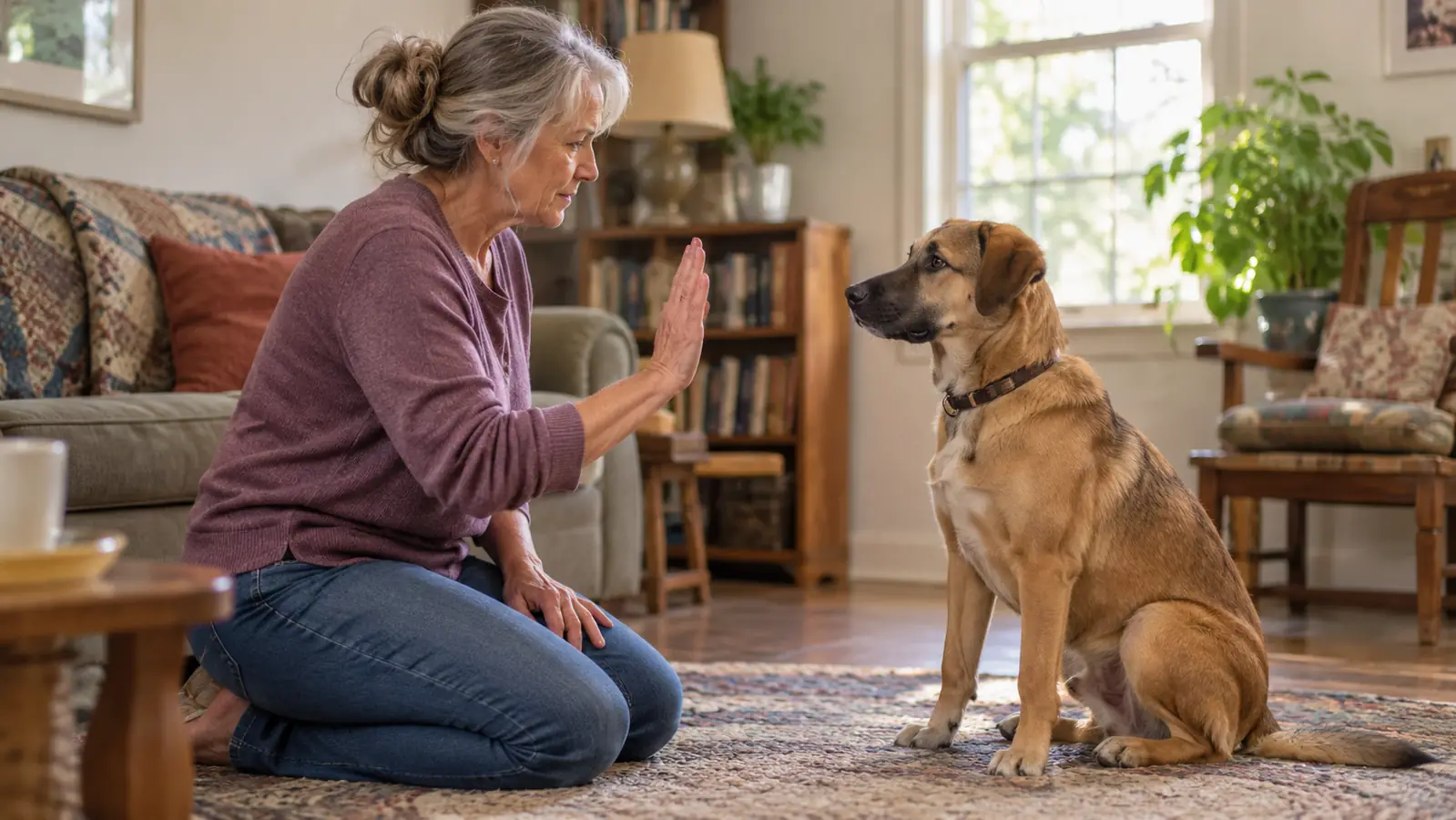
I bought the Starmark Pro-Training Clicker in late March, about three weeks after Moose came home from the shelter. Before that I had been saying the word yes in what I hoped was an encouraging voice, the way I had watched people do in the videos. Both of them worked. They just did not work the same way, and after eight months of going back and forth between a clicker and a plain spoken word, I can tell you which one was easier for me to learn.
Here is the short answer. If easier to learn means easiest to get right on the first try, the clicker wins. It makes one sound, it makes that sound the same way every time, and the moment I pressed it was the exact moment Moose got paid. If easier to learn means nothing to buy, nothing to hold, and nothing to remember while you are standing on a sidewalk with a leash wrapped around your wrist, then your own voice wins, and honestly it is not close.
So I use both, in order. The clicker taught me when to mark a behavior. The word is what I reach for now when my hands are full. The table below is the long version of that answer, row by row, including the rows where the word wins.
| Starmark Pro-Training Clicker | A verbal marker word | |
|---|---|---|
| What you need before the first session | One clicker, hung by the back door with the leash | Nothing. You already have your voice. |
| Timing the exact moment | Same sharp sound the instant the behavior happens | The word slides about half a second late when you get excited |
| Same sound from two people | My husband presses it and it sounds like mine | Gary says it lower and slower than I do |
| Hands free on a walk | One more thing to hold along with the leash | Nothing to hold and nothing to drop |
| First week with a nervous dog | The click is sharp, and Moose took about a week to stop flinching at it | A soft spoken word never startled him once |
| Marking a fast behavior | Catches a head turn or a single paw lift | Hard to land on anything quicker than a sit |
| Teaching a second person the system | Show them one press and they have it | Takes weeks of reminding them to keep the tone flat |
| What you use for the rest of the dog's life | Usually faded out to a word once the behavior is solid | Already the thing you will keep using |
| Best for | Precision work, new behaviors, a two person household | Walks, quick captures, shy dogs, hands full of groceries |
Where the Starmark Clicker Wins
Timing is the part nobody warns you about. When I was marking with my voice, I kept landing about a beat after the behavior. Moose would sit, I would say yes, and by the time the word left my mouth he had already started to shift his weight or glance at the treat jar. That half second was exactly the information he needed and I was handing it to him late, over and over, for a couple of weeks before I figured out what I was doing wrong.
The Starmark clicker fixed that for me, mostly because a button is easier to press on time than a word is to say. The listing puts it at 0.4 ounces, it sits in my hand with room left over, and the stainless steel clicker element has not rusted even though mine hangs by a back door in South Carolina humidity. The bigger thing was consistency between two people. Gary presses it and it sounds exactly like when I press it. When Gary says yes, it comes out lower and slower than mine, and Moose is not a scientist but he can hear the difference. That matters in a house with two people and one dog, because a marker only works if it sounds the same every single time it is used.
Where the Word Wins
The word wins on the days you cannot carry one more thing. On a walk I have the leash in one hand, the clicker in the other, and the treat pouch wedged under my arm, and it is a lot of moving parts for a woman who used to keep her whole life in one purse. When Moose finally stopped pulling toward a squirrel and looked back at me, I said yes, because both hands were busy. That is not a small advantage. It is the reason people quit on clickers, and it is the reason I still say the word more often than I click.
It also wins with a nervous dog, at least in our house. Moose was jumpy about noise when he came home in March, and a sharp click right beside him took about a week before he stopped flinching at it. He got there and I never had to work around it again, but a soft spoken word never made him flinch in the first place. If your dog is sound sensitive, mark quieter and slower than you think you should, and load the sound before you ask for anything. If your dog is showing fear, guarding, aggression or any bite behavior, that is a conversation for your vet or a certified trainer, not for a clicker on a hook.
The tool that taught me when to say yes
If timing is the piece you keep getting wrong, this is where I would start. It is one small clicker, light enough to live on the leash hook, with a stainless steel clicker element the listing says will not rust. In our house it made me a more accurate teacher within about a week of short sessions. It is not a fix on its own and it will not suit every dog.
Amazon Check Today's Price on Amazon →How I Loaded the Clicker in My Kitchen
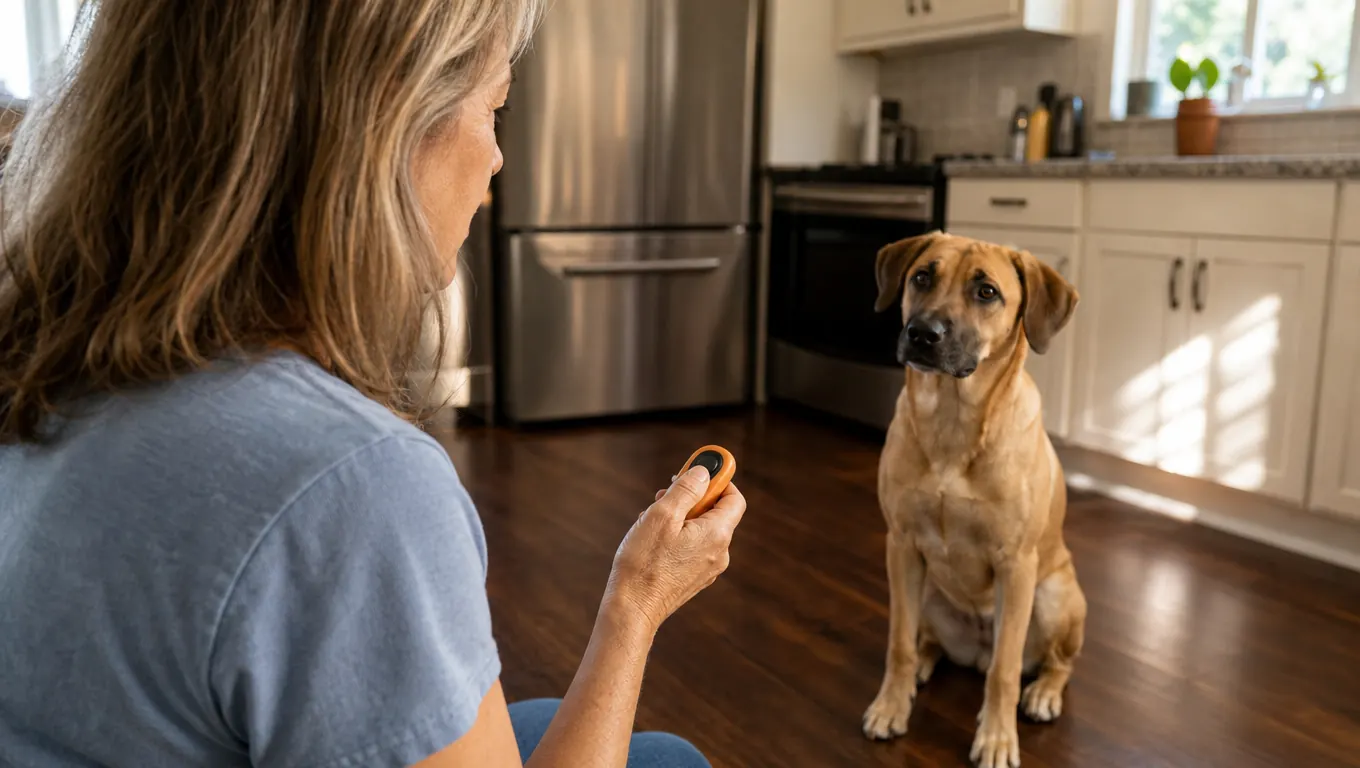
The first thing I did with the Starmark clicker had nothing to do with obedience. I stood in my kitchen with a bowl of kibble, clicked the thing, and gave Moose a piece of food. Click, treat. Click, treat. Twelve times, maybe fifteen, over about two minutes, and then I put it away. That is the whole loading step. The sound means food is coming, and it means that before you ever ask the dog to do anything at all.
Then we did sit, which he already half knew, and the difference was obvious by the third repetition. He was not guessing anymore. He would put his rear down, I would click at the exact instant it touched the floor, and he would look up at me like the transaction had finally been explained to him in a language he could hear.
One note on handling. I press it with my thumb, behind my back or down at my hip, not out in front of his face. The point is the sound and the timing, not the object. That was a correction a neighbor who trains bird dogs gave me over the fence, and it was a good one. A clicker waved in a dog's face is just a thing to stare at.
He was not wrong. I was late. That is the whole difference between a click and a word, and I only understood it after I had done both of them badly.
How the Jumping Went With Each One
The real test in our house was the front door. From April through June, every time a guest knocked, Moose went up like a bottle rocket, all four feet off the ground and his front paws on somebody's chest. My plan was simple. Wait for four paws on the floor, then mark that exact moment and pay him for it.
With the clicker in my hand behind my back, I could catch the instant his back feet landed, even with a neighbor filling the doorway and the storm door propped on my hip. Click, then he came to me for the treat, and the jumping stopped being the thing that paid. It took weeks. It was not one session and it was not a switch that flipped.
When I tried the same plan with the word, I could not say it fast enough while also holding the door and saying hello. The yes came out a second late, which meant I marked him for standing there looking confused rather than for having all four feet down. He was not wrong. I was late. That is the whole comparison in one sentence, and it took a door and a neighbor for me to see it.
What Nobody Tells You About Fading It Out
Here is the part that surprised me. You end up back at the word anyway. A clicker is a teaching tool, and once Moose knew something cold, I swapped the click for a spoken yes and he kept doing the same behavior. The clicker was never the point. The point was the exact moment, and the clicker is how I learned to find that moment with my own two hands.
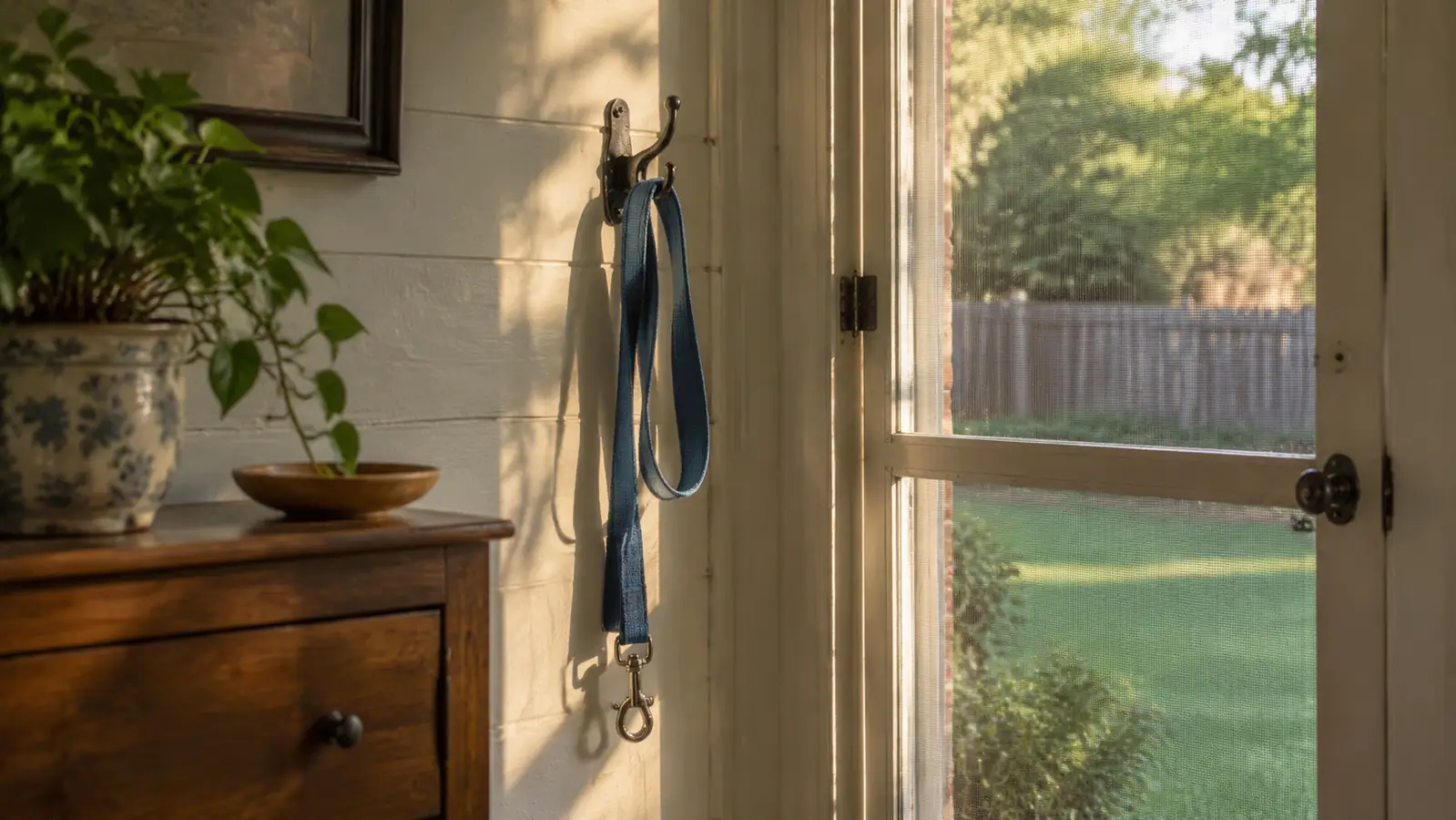
That is why I do not think anyone has to pick a side forever. Mine lives on the hook by the back door next to the leash and the harness, and I still take it out when I am teaching something new, a few short sessions a week. Everything he already knows runs on the word now. If that sounds like learning a tool and then setting it down, that is exactly what it is, and I do not think it is a waste.
The other thing nobody tells you is that the dog does not care which one you choose. Moose cares that the information arrives at the right time and that something good follows it. All the agonizing I did about clicker versus voice was about me, not about him.
What I'd Tell a Friend Who Just Adopted
Pick one marker and stay with it for a month. I switched back and forth for a while, clicker on Monday and word on Tuesday, and I was the one who got confused. Your dog can learn both, just not on the same afternoon for the same behavior. Load the clicker first, a dozen clicks and treats in the kitchen while nothing is being asked of him, so the sound means something before you use it for a lesson.
Keep it where you will see it. Mine hangs by the back door with the leash and the harness, which is the only reason I ever remember to bring it. Put it in a drawer and it is gone. That is true of every piece of dog gear I have bought this year, and I have bought five of them since February.
And do not ask a marker to fix something bigger than manners. If your dog is guarding food or a couch, if there is growling or a bite, or if the anxiety is not settling after months of work, call your vet and find a certified trainer who can see your dog in person. I am a retired dental office manager with a clicker and a rescue dog, and I would not want you to think a small clicker is the answer to that.
Who Should Buy Which
Buy the Starmark clicker if your problem is your own timing, if two people in the house are training the same dog, or if you are working on something fussy like a head turn, a paw target, or four paws on the floor at the front door. It is small, it hangs on a hook, and in our house it made me more accurate within a week of short sessions. I would buy it again for the door work alone.
Skip it and use your voice if you are mostly working on walks, if your dog is shy or sound sensitive, if your hands are always full, or if you already have decent timing with a word. You will end up on a word most of the time anyway. The only thing I would not do is try to learn both at once with a dog who is still settling into a new house, because that is more for you to remember than for him to learn.
One sound, one exact moment, one week of short sessions
Start small. A sit, a dozen clicks, a handful of kibble on the kitchen floor. If timing is the thing you keep missing, this is the tool that showed me mine. It helped us. It will not work for every dog, and it is not a substitute for a trainer when the problem is bigger than house manners.
Amazon Check Today's Price on Amazon →