
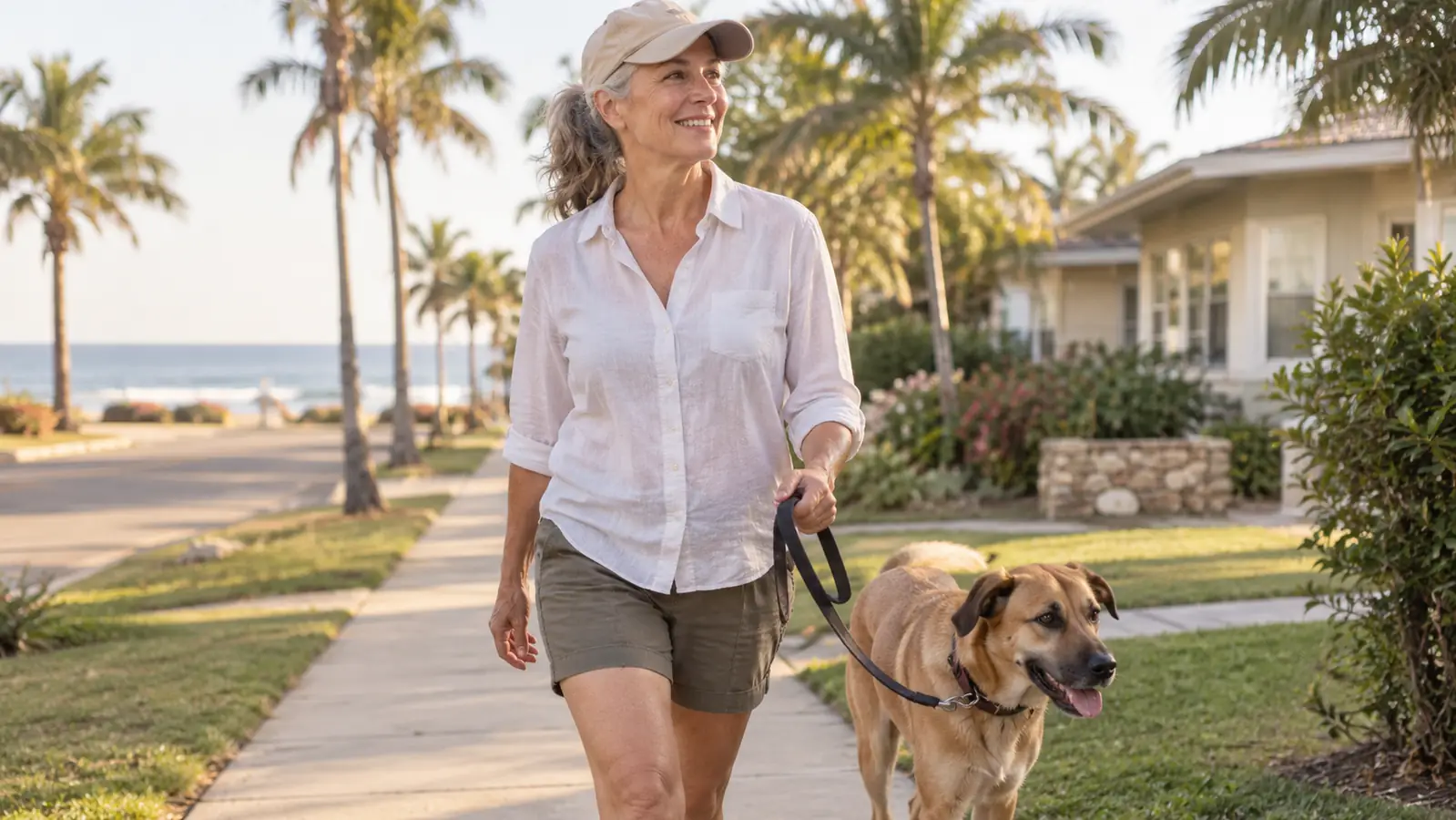
By the middle of May, my right shoulder had opinions about our morning walk. Moose came home from a Myrtle Beach shelter in early March at about four months old, and by spring he was a long-legged forty-five pound teenager who believed the sidewalk was a race track. The plain collar and leash he arrived with were fine for a four-month-old. They were not fine for a dog who lunged at every squirrel on our street. I am not a trainer. I am a retired dental office manager who reads every label and keeps notes, and I bought the PetSafe Easy Walk Harness in May, in a size Large, when Moose was around thirty-five pounds, mostly because my shoulder was sore and I had run out of ideas.
Here is the honest version. A front-clip harness is equipment, not a behavior fix, and it will not turn a determined puller into a show dog. What it does is change two things: where the pressure lands on the dog, and where the steering happens. In our house that was enough to make walks pleasant again most mornings. Below are ten reasons it helped us, roughly in the order I noticed them, with the caveats attached. If your dog has bitten, guards food or shows serious fear on walks, skip the gear advice and call your vet or a certified trainer first.
The clip on the chest is the whole idea
The PetSafe Easy Walk puts the leash ring on the front of the chest, so a pull turns the dog instead of dragging you down the block. It is the first piece of gear I bought for Moose that changed our mornings.
Amazon Check Today's Price on Amazon →It takes the pressure off his throat and puts it across his chest
When Moose hit the end of his leash on the shelter collar, all of it landed on the front of his neck, and he made a gagging sound I did not like. The Easy Walk attaches the leash at the chest instead. The listing describes a martingale loop design that puts gradual pressure on the shoulders, and that matches what I see: the pull is spread across a wide part of him instead of one narrow band. He still wears his collar for tags. The leash just does not go on it anymore.
The harness does the reminding, so my arm does not have to
This is the part I understood slowly. When he pulls, the front loop on the PetSafe harness tightens gradually, and the moment he eases off it loosens again. I am not yanking a dog around the block and I am not leaning back with both hands on the leash like I am water skiing. The release matters as much as the pressure. Within a couple of weeks Moose had worked out that the tight feeling went away when he stopped charging and came back when he walked beside me.
You steer from the front, so he turns instead of dragging you
A leash clipped to a back ring pulls a dog forward. A leash clipped at the chest pulls him sideways, and his body has to follow his nose. The first time Moose locked onto a cat across the street, I did not pull back. I turned my hand toward my hip and he swung around to face me instead of hauling me toward the road. It felt less like correcting him and more like steering a small boat. My shoulder liked it.
It goes on in seconds, which matters with a wiggly dog
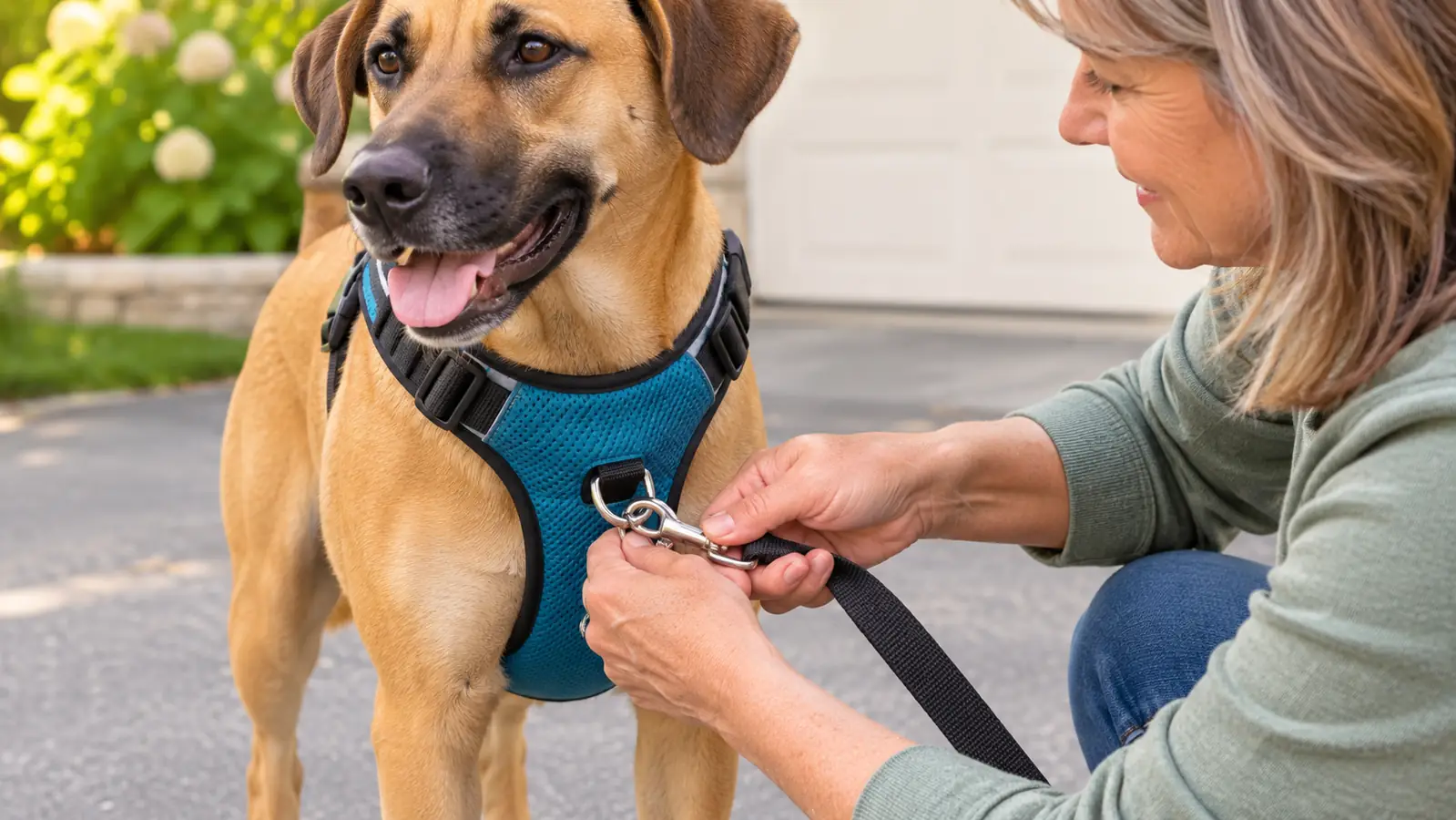
There are quick-snap shoulder straps and a buckle closure, so I open it up, lay it over his back and close the snaps while he stands on the driveway pretending he cannot hear me. No step-in, no lifting a paw through a loop. When he was younger and squirming, that speed was the difference between getting out the door and giving up on the walk entirely. The quick start guide that came with it walked me through the strap order the first time.
The belly strap is a different color, so I can tell the straps apart at a glance
Small thing. Big deal when you are crouched over a moving dog. The belly strap is a different color from the rest of the harness, which means I grab the right strap the first time instead of untwisting the whole thing on the driveway. I check the fit the way the guide suggests, snug enough that I can still slide a couple of fingers under the straps, and I refit it whenever he seemed to change shape. That happened twice between May and September.
It weighs a little over nine ounces, so he forgets he is wearing it
The listing puts the harness at 9.28 ounces, not much more than his collar. Moose does not walk stiff-legged in it or freeze at the door the way some dogs do in heavy gear. Light equipment means he can still be a dog in it: sniff the base of every palm tree, flop down in the shade halfway home, roll on his back in the grass by the beach access path. Nothing about it makes him move like he is in a costume.
The fit has room to change as a puppy fills out
He was around thirty-five pounds when I bought the Large and he is about forty-five now. The straps adjust, and I have taken them in and let them out twice as his chest deepened. If you are buying for a dog who is still growing, measure the chest before you order rather than guessing from the breed or the shelter paperwork. Moose measured smaller than I expected, and I read the sizing twice before I clicked anything.
It handles a beach town without falling apart
It is nylon, it is hand wash only, and it carries a one year manufacturer warranty. Mine gets rinsed in the laundry sink after a salty morning on the sand and hung over the back railing to dry, and it has held its shape since May. The stitching around the front ring is where I look, since that is the part taking the load, and it still looks like it did in the spring. I would not put it in the washing machine, even on a gentle cycle.
He can still be a normal dog in it
A harness that stops a dog from sitting, sniffing or taking a treat will annoy both of you, and annoyed dogs pull harder. Moose sits at curbs, lies down in the shade when it is hot, and takes a piece of kibble from my hand while wearing it. Because the leash ring sits at the front of his chest rather than over his shoulders, nothing pulls at his neck when he lowers his head to sniff something interesting. That sounds like a small detail. It is the reason he puts it on without a fight.
It gave me back the morning walk
This is the real reason I am writing all of this down. In April I was skipping the second walk because my shoulder ached and the walk itself was a wrestling match. By June we were doing the loop twice a day, mornings before the heat and evenings after dinner, and I was the one choosing the route. He still pulls when a squirrel crosses the sidewalk. He is a year old and full of opinions. But most mornings I walk him with one hand and a loose leash.
What I'd Skip
A few things I would not buy again, or would not buy at all. A back-clip harness for a dog who already pulls is the big one, because a leash attached over the shoulders gives a dog something to lean into, which is the opposite of what I needed in May. If you are deciding between the two styles, I laid out the side by side in my front clip versus back clip comparison, and the short version is that a back clip is fine for a dog who already walks politely and not much help for one who does not.
I also skipped a head halter. Not because they never help, but because I did not feel qualified to fit one without a trainer showing me, and a badly fitted one on a nervous young dog seemed like a bad trade for my shoulder. I skipped a retractable leash entirely. And I skipped the tempting idea of buying a size up so he could grow into it. A harness that is too big slides and rubs, and the whole point is a snug fit. If your dog shows real fear, lunges with serious intent, or cannot settle at all on a walk, that is a vet or certified trainer conversation, not a shopping one.
He still pulls when a squirrel crosses the sidewalk. But most mornings I walk him with one hand and a loose leash, and my shoulder stopped aching in June.
If your shoulder is the one taking the beating, start here
The PetSafe Easy Walk is the piece of gear that made our twice-daily walks possible again. Measure the chest, follow the quick start guide, and give it a couple of weeks before you decide. It helped us. It will not suit every dog.
Amazon Check Today's Price on Amazon →