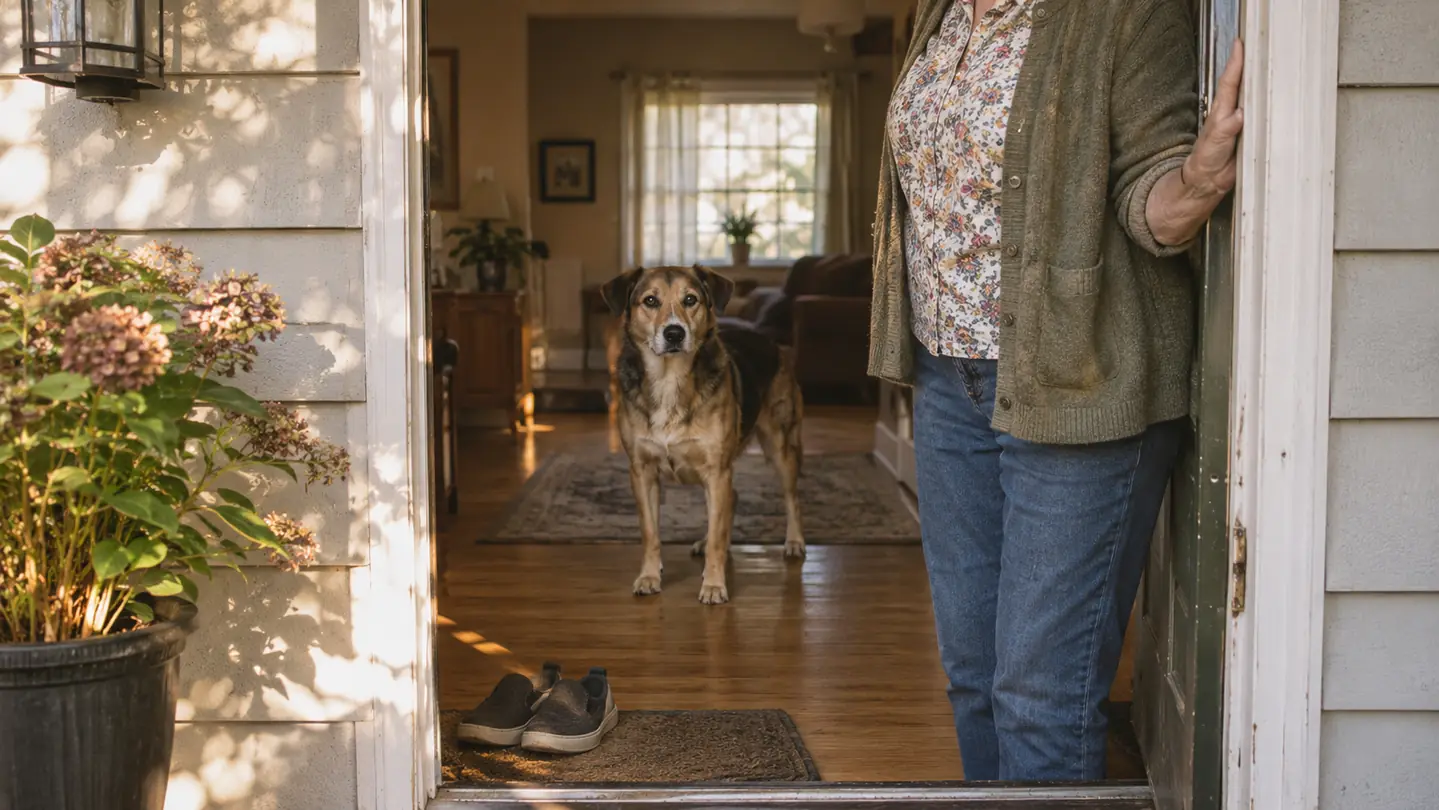
The first time my neighbor Carol stopped by to see the new house, I had one hand on Moose's collar and the other on the doorknob, and it did not matter. He got air. Forty-five pounds of dog, all four feet off the floor, nose pointed at her reading glasses. Carol laughed it off. I did not sleep well that night.
Before the clicker I tried what everybody tries. I held the collar tighter. I said down in a voice that got louder every week. I waved a treat over his head, which worked right up until he noticed the treat was in my hand and Carol was still standing there, and then he went back to her. What I did not understand yet is that I was paying him for jumping. Every time a person came through that door, he got the best thing in his world, which is a new human to smell. I am not a trainer and I am not a behaviorist. I am a retired dental office manager in Myrtle Beach who read every label and kept notes on a yellow pad. The Starmark Pro-Training Clicker is the tool that finally gave me something useful to do with my hands at the door, and the five steps below are what we actually did in our house, in the order we did them. Moose is a mixed breed rescue, about a year old now, and he is smarter about the door than I was for the first two months.
The clicker that replaced my shouting at the front door
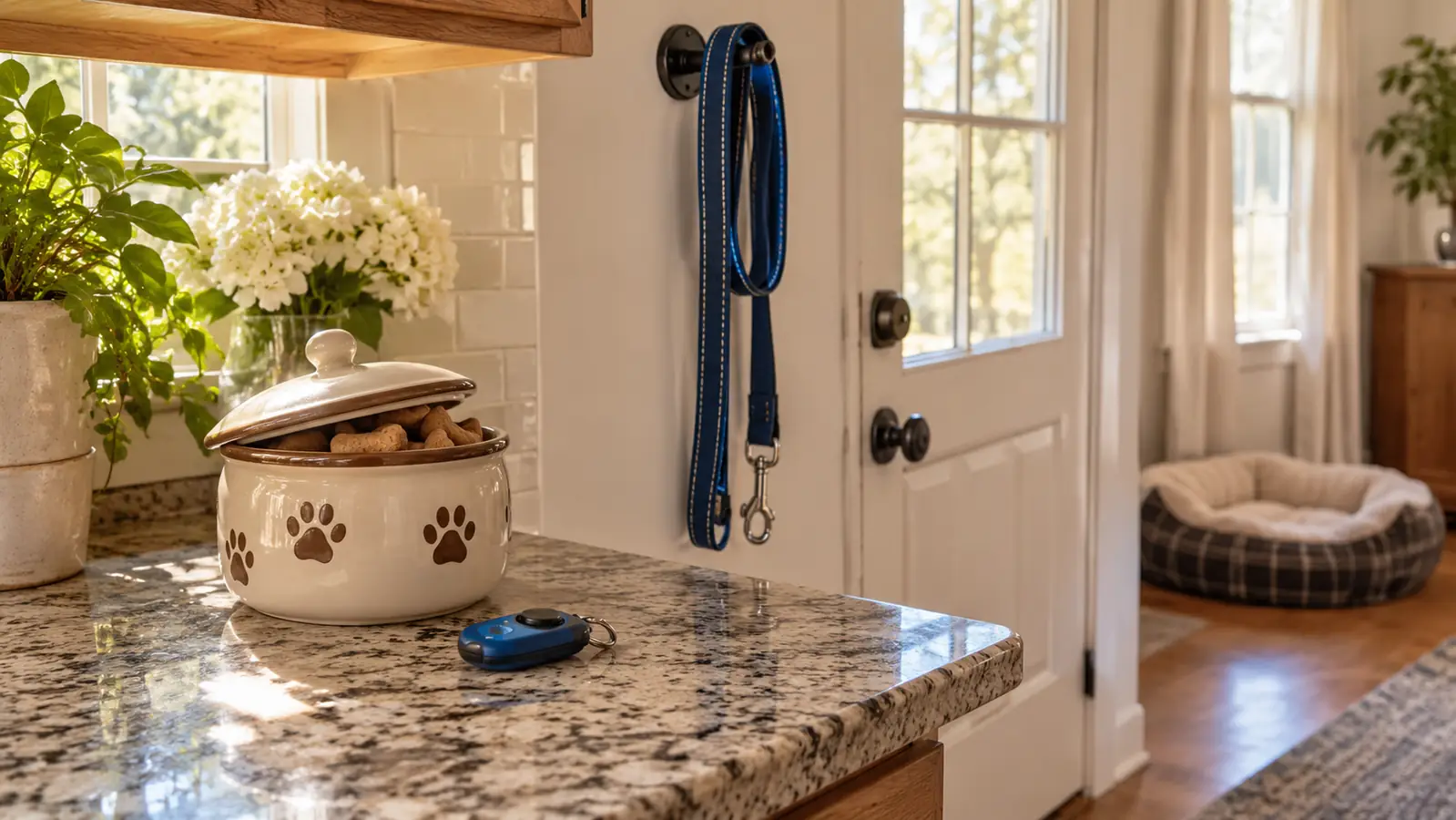
The Starmark Pro-Training Clicker is a small clicker, about 2.3 by 1.5 by 0.8 inches and 0.4 ounces, with a stainless steel clicker element the listing says will not rust. It hangs on the leash hook by my back door, and it is what I used from April through June to teach Moose that four paws on the floor is the paid position. If you are standing on your porch apologizing to a delivery driver, this is where I would start.
Amazon See the Starmark Clicker on Amazon →The Five Steps, In the Order I Did Them
Step 1: Charge the clicker before you need it
A clicker does nothing on its own. The first three days I never took it to the door. I sat on the kitchen floor with a bowl of kibble, clicked, and fed. Click, treat. Click, treat. Ten reps, twice a day. That is the whole session. The idea is simple and it is the reason the rest of this works: the click marks the exact second the dog did something right, and the treat pays for it. If the click does not reliably mean food is coming, it is just a noise, and on the night a stranger is in the doorway Moose has much better things to listen to.
Two things I got wrong at the start. I reached for the treat first and clicked after, so the click meant nothing. And I clicked a dozen times in a row while he was doing nothing in particular, which teaches a dog precisely that. One behavior, one click, one treat. If I fumbled and the treat hit the floor, I still gave him one from the bowl, because a click that does not pay out is a broken promise and he keeps score better than I do.
What I like about the Starmark in this step is that it disappears. It measures about 2.3 by 1.5 by 0.8 inches and weighs 0.4 ounces, and the listing says it attaches easily to a keychain. Mine lives on the hook by the back door with the leash, so I am never digging through a drawer while somebody waits on the porch. The listing also describes an ergonomic design that fits comfortably in the hand, which sounds like marketing right up until you have clicked through a hundred reps in a week.
Step 2: Pick one behavior that makes jumping impossible
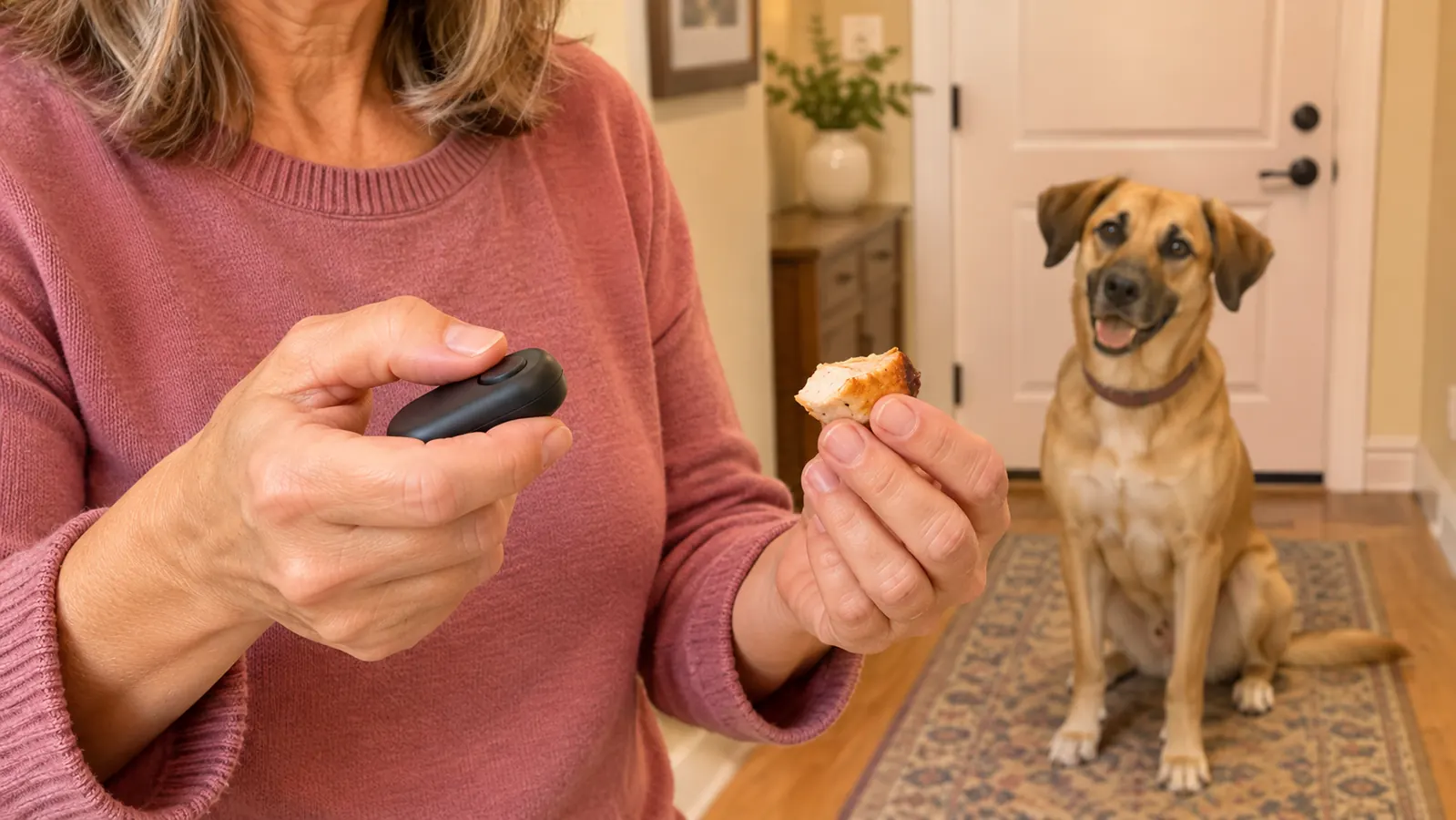
You cannot click a dog for not jumping. You can only click him for doing something else. Ours was four paws on the floor, about three feet back from the door. That is not obedience, it is geometry. A dog standing back with four feet down is not also nose to nose with your guest.
I started in the hall with nobody there. I stood by the closed door and waited. The second all four feet were down, click and treat. He bounced at my pocket, I waited, he came down, click and treat. The first night took about six minutes before he worked out that standing still was the paid position. By the third night he was offering it before I asked.
Then I added a rug about six feet from the door and paid him every time he stood on it. Moose is food motivated, which is not the same as easy, it just means the payment clears. If your dog would rather have a ball than a piece of chicken, use the ball. Short sessions, five minutes, and stop while he is still winning.
Step 3: Rehearse the door before a real guest is standing in it
This is the step I would tell a friend not to skip. I had my husband Gary go outside and ring the bell while I stayed in the hall with Moose on leash and the clicker in my hand. Gary is not a stranger, but the bell is the bell, and the bell was most of the problem. First ring, Moose barked and launched. I did not correct him. I stood still and waited, and when four paws came down I clicked and paid him with a piece of chicken, which is the good stuff and only appears for door work.
Three rings a night, no more, then we stopped. Inside a week he was turning toward me when the bell rang instead of throwing himself at the frame. Not because he had decided to be good, but because the routine had changed and the rug was where the chicken lived.
One warning from my own mistakes. Do not open the door during this step. The rehearsal is the bell, the wait, the click, the treat, and then Gary comes back in through the garage. If you open the door before your dog can hold four paws down for five seconds, you have just paid for jumping with the best reward there is, which is a person.
A clicker does not stop a dog from jumping. It lets you pay for the exact second he is not.
Step 4: Add one real guest, leash on
The first real test was Carol again, on purpose, because she had already seen the worst of it. I asked her to text when she pulled in so I could have Moose on the rug with the clicker in my hand and the chicken on the hall table. She knocked. He barked once, came back to the rug, I clicked and paid. Then I opened the door with my foot behind it and asked her to walk in without looking at him. No eye contact, no high voice, no reaching down. That last part matters more than anything I did with the clicker.
He jumped once, at the doorway. I stepped in front of him and said nothing. He came down, I clicked and paid, and Carol sat on the couch and ignored him for two solid minutes, which is the hardest thing I have ever asked a guest to do. Since nothing he did got him a greeting, he went and lay on the rug. The second guest was worse, because he had a hat. Hats count.
Real guests are not training props and they will not always cooperate, and that is fine. The leash is not because Moose is dangerous, he is not, it is because a leash keeps a rehearsal a rehearsal. When it falls apart, and it will, I take him to the back hall with a chew and let Gary answer the door. That is not losing. That is knowing what my dog can handle on a Tuesday night.
Step 5: Fade the clicker and keep the greeting short
By June I was clicking once a visit, then once every third visit, then not at all for a week. The fade is the point. The clicker is a teaching tool, not a leash. Once Moose parked himself on the rug when the bell rang, the chicken did not have to appear from my hand every single time. Sometimes it comes from the guest, sometimes it does not come at all, and he still does the job.
What I still do, every single time, is keep the greeting short. Thirty seconds of calm and then I walk the guest into the kitchen and Moose gets a frozen KONG or a LickiMat on his mat. That is not a reward for jumping. That is me removing the audience before he gets bored enough to try it. Most of the jumping in our house happens at minute three, not minute one.
The Starmark still hangs by the back door. I use it for new things now, a few short sessions a week, because a dog who has learned that a click means a lesson is easier to teach everything else. That has been worth more to me than the door.
What Else Helps
The clicker is one part of this and I would not pretend otherwise. The biggest change at our door was asking people to ignore Moose for the first two minutes. No eye contact, no baby voice, no hand out for him to sniff. He is nervous with new people and a hand coming at his face is the thing that starts the jumping in the first place. When guests ignore him, he settles faster and I get to stop being the woman who apologizes at her own front door.
A walk before people arrive helps in our house. Not because it tires him into good behavior, it does not, but a dog who has already sniffed the block is a little less desperate about the doorbell. We use the PetSafe Easy Walk harness with the front clip on every walk, because he still pulls when he sees a squirrel, and a sore shoulder on my end does not make me a patient trainer.
The mat and the LickiMat do the part the clicker cannot, which is giving him a job after the greeting is over. I spread plain yogurt or a thin layer of peanut butter and freeze it, and he gets it on the kitchen floor while we sit and talk. I pick the mat up before I leave the room. He is never alone with it, and it gets hand washed in the sink.
One more thing, and I mean this. If your dog is growling, snapping, baring teeth, or backing a guest into a corner, this is not a jumping problem and a clicker is not the answer. Call your vet and find a certified trainer who can see the dog in person. I am a woman with a clicker and a yellow pad. That is all I am, and a blog post should not be the last word on a dog who is scared.
One click and one piece of chicken beats another round of shouting
Moose is not a perfect dog. He still barks at the mail truck and he still forgets himself when a guest has a hat. But the door stopped being a fight in our house, and it started with a clicker that fits in a jacket pocket and a bowl of chicken on the hall table. If you are at the beginning of this, that is where I would put my time.
Amazon See the Starmark Clicker on Amazon →