
Night three with Moose was the worst of them. He came home from a Myrtle Beach shelter in early March at about four months old, and for the first two nights I gave up somewhere around midnight and let him sleep on the bedroom floor next to the bed. On night three I decided to let him cry. He went for forty minutes. My husband Gary got up twice, once to check the back door and once just to stand in the hallway looking at me. I lay there in the dark doing math on whether I had already ruined a dog I had owned for seventy-two hours.
Here is what I wish the shelter had told me at the door. The crying is not one problem. It is three problems wearing the same coat. You have a puppy who has never slept without his littermates, a puppy with a bladder the size of a walnut, and a puppy who has just learned that crying makes a person appear. The MidWest Homes for Pets 36-inch single door iCrate we bought the week before he came home did not fix any of that on its own. What it gave me was a crate correctly sized for the dog he would grow into, with a divider panel I could use to shrink it down while he was small. The rest was a routine I had to build around it, and that is what this page is.
The one crate that fit him at four months and still fits him at forty-five pounds
The MidWest Homes for Pets 36-inch single door iCrate is listed for dogs in the 41 to 70 pound range, and it arrives with the divider panel, a removable leak-proof tray, rubber feet and a carry handle. Assembly is tool-free, it folds flat for the car, and the listing shows a one year manufacturer warranty. It currently carries a 4.7 rating across more than 111,000 reviews.
Amazon Check Today's Price on Amazon →Step 1: Make the crate smaller than feels right
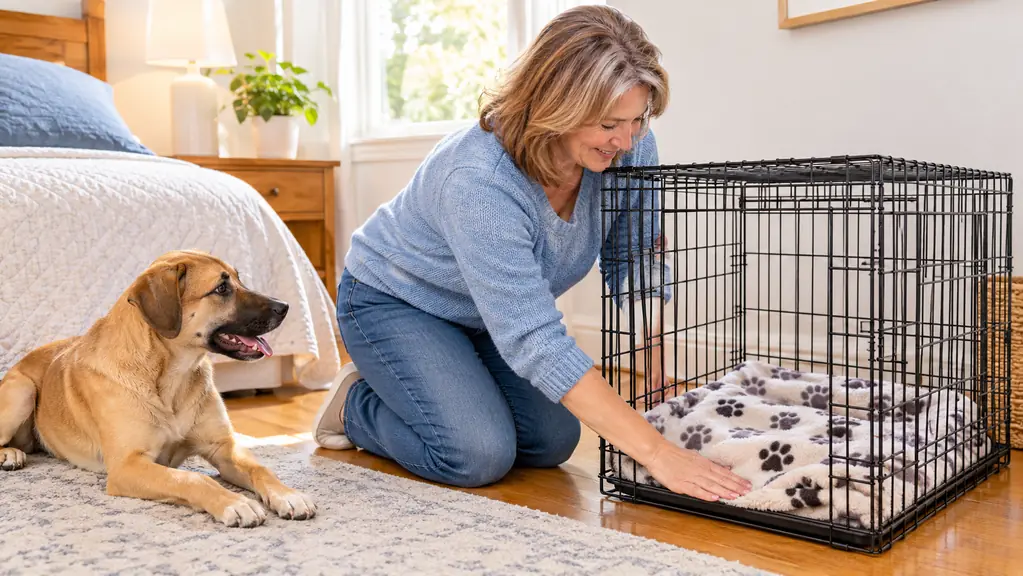
Moose was about twenty-two pounds the week he came home. The 36-inch iCrate is listed for medium to large breeds in the forty-one to seventy pound range, so at four months he could have rattled around in all of it. The listing says the divider panel is included, and that divider is the reason I bought this size instead of a smaller puppy crate I would have had to replace by summer.
A shelter volunteer told me the rule she uses, and I followed it. Set the divider so the puppy can stand up without ducking his head, turn around, and lie flat on his side. Nothing more. Give a puppy extra floor space and he will pick the far end to potty in and sleep in the near end, which is a harder habit to break than the crying ever was. I checked it with my hand instead of my eye. If I could lay my palm flat between his back and the divider while he stood there, I had given him too much room and I moved it in a notch.
I moved the divider back twice as Moose grew and pulled it out for good in June. The first move was in April, after about a week of him sleeping with his chin pressed against the wire because he had outgrown the space I left him. I got the tape measure out, set the new position, watched him walk in and turn around without ducking, and then left it alone. The second move was in May. He just turned one, he is about forty-five pounds and still filling out, and he sleeps in that same crate every night with room to spare. One purchase, three sizes.
Step 2: Build a bedtime routine that ends inside the crate
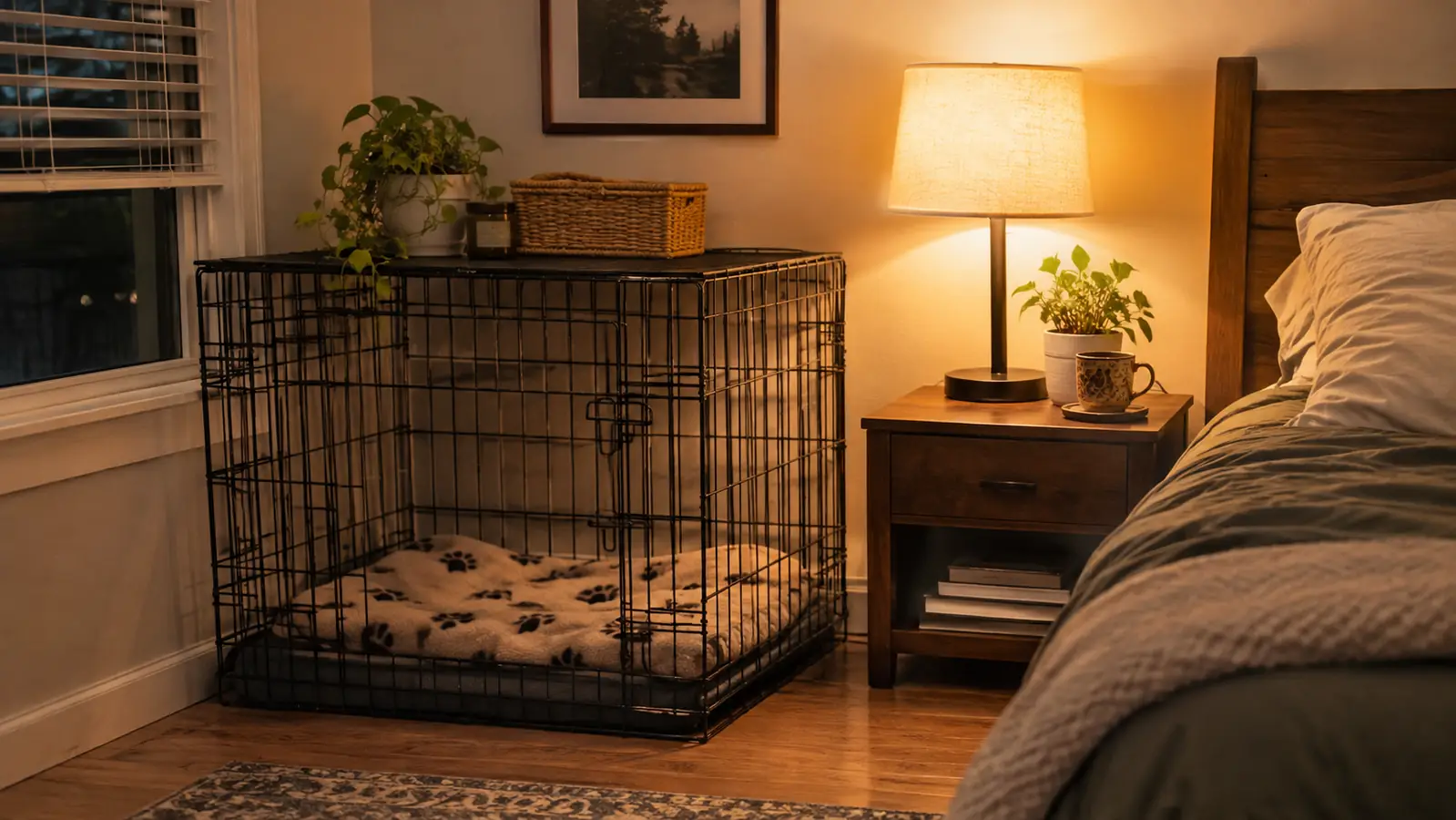
The first thing that helped was where the crate sat. We put it in the bedroom, in the corner next to my side of the bed. A puppy who can hear you shift around is a different puppy from one alone down the hall in a laundry room. If you have a corner near where you sleep, use it. Ours has stayed in that same corner since February.
Then I made the last half hour of the evening boring and identical. Water bowl up about an hour before bed, which in our house is a quarter past eight. One last trip outside to the same patch of grass at the edge of the yard, on the leash, so he learned what that trip was for. Back inside, straight to the crate, one small piece of kibble tossed in, door latched, lights off by nine. No wrestling, no long goodbye, no fifteen minutes of baby talk that tells him something enormous is about to happen.
I broke that order plenty of times. If Gary came home late there was a joyful reunion at nine at night and the puppy was wound up until eleven. One Saturday I took Moose down the beach access path too late in the afternoon and he came home overtired, which is a real thing in puppies and looks a lot like being wired. The nights the routine ran start to finish in the same sequence were the nights he settled in under five minutes. The nights it did not, I usually knew by half past nine what kind of night we were in for.
Ten nights of crying, and then one night he walked in ahead of me, turned twice, and lay down. The crate had not changed. The routine had.
Step 3: Make the crate the good room during the day
A crate that only ever means the door closing will always be a place a puppy argues with. So during the day I fed Moose his meals inside it with the door propped open. I dropped a piece of kibble in when he was not looking, walked past, and said nothing. He would wander in, find it, wander out. That is the whole point. You are not teaching a command, you are letting the furniture pay him. I did this at both meals for about three weeks, and I kept an old fleece of mine in there the whole time, one that already smelled like the house.
I never used the crate for a time-out. Not once. It is not a punishment in this house and he has no reason to read it as one. When he was being a pest at four months old, which was most of the day, I put him in the back yard or kept him on a leash beside my chair, never in the crate.
By the third week he was napping in it on his own with the door open. Now the door stays open all day and it is where he takes himself when the neighborhood gets loud, which for a dog who is nervous about noise is worth more than I expected.
Step 4: Answer the middle-of-the-night crying the same way every time
He cried for about the first ten nights. Not the whole night. It came in waves, usually somewhere between two and four in the morning. The rule I settled on was one quiet trip outside per night while he was that small, because a four month old bladder is a real thing and I did not want him learning to soil the crate. That trip had no talking, no play, no overhead light, just the hall light and the leash. I carried him down the two steps to the yard so he would not wake himself up properly on the way. He went, I said nothing, we came back in. The whole thing took about four minutes.
Then straight back in, door latched, me back in bed. If he cried again after that, I lay there and did not get up, unless the sound was different. A puppy who is wet or hurt or genuinely panicking sounds different from a puppy who is complaining. Complaining has a rhythm to it, with little pauses in the middle where he stops and listens for footsteps. The other kind does not pause. If you are not sure which one you are hearing, that is a question for your vet, not for a blog.
I got this wrong twice in the first week, once by sitting on the floor beside the crate until he fell asleep and once by bringing him into bed. Both of those made the next night harder. That is not a moral failing, it is just how it goes. Pick the rule back up the following night.
Step 5: Practice the closed door in daylight before you ask for a whole night
Before I expected him to hold it together for eight hours in the dark, I asked for two minutes in the daylight. Door latched, me sitting on the bedroom floor folding laundry. Then me standing in the doorway. Then me in the next room. Two minutes became five, five became fifteen. He was four months old, so a lot of these were very short, and some of them ended with him telling me off through the wire.
About two weeks in, once teething started and he chewed a kitchen table leg and a pair of Gary's slippers, I bought a large KONG Extreme. I soak kibble, pack it in, cap it with a thin layer of peanut butter, and freeze it overnight. That frozen KONG goes in the crate when I leave for an errand. It is still the same KONG, months later, and nothing has come off it.
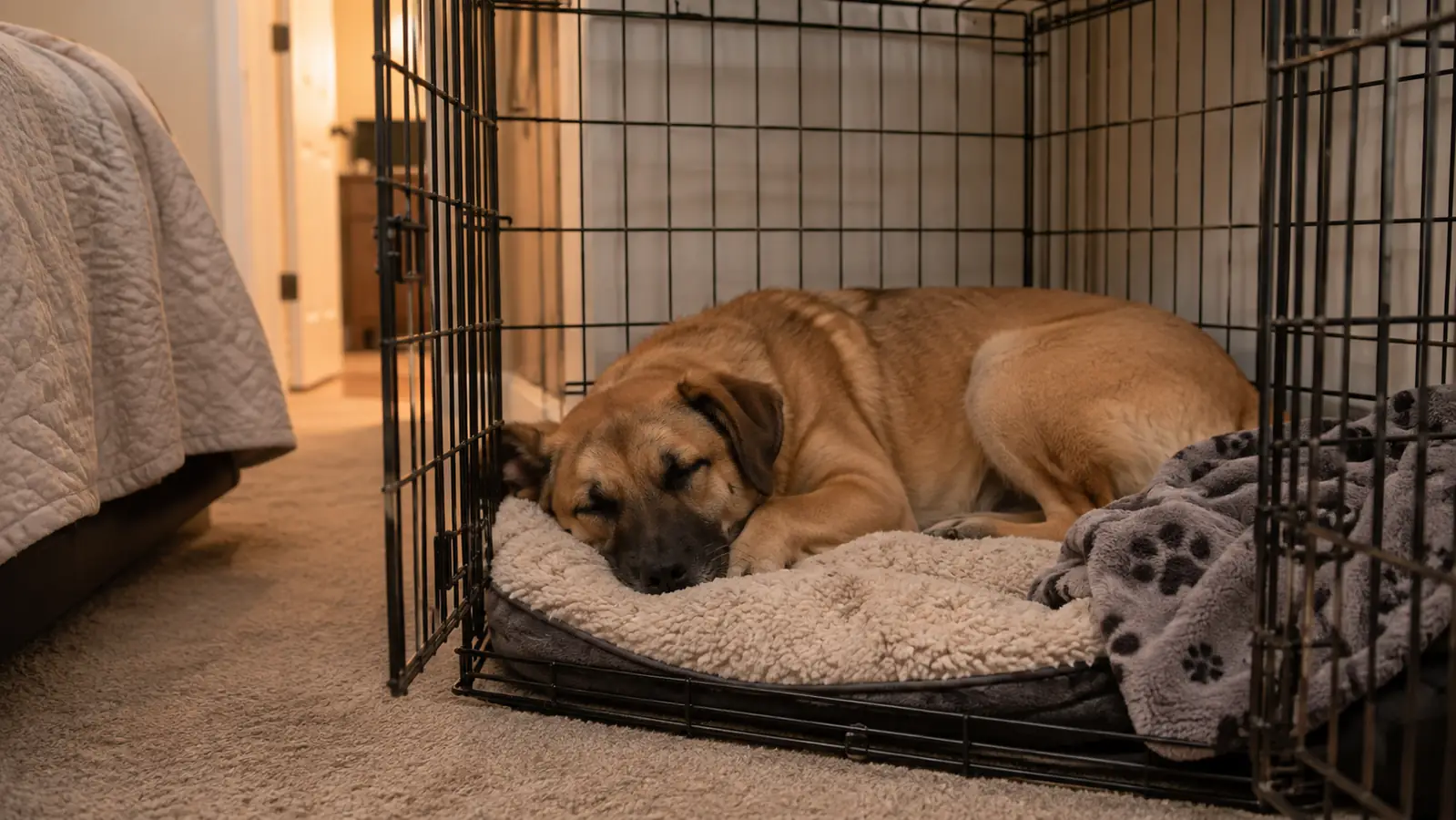
By night ten he walked into the crate ahead of me. He turned around twice and lay down. In our house, that was the turn.
What Else Helps
The LickiMat came in April, after a stretch of thunderstorms and a nail trim that went badly for everybody involved. I spread plain yogurt or a spoon of wet food on it, sometimes freeze it, and set it on the kitchen floor while I sit nearby with my crochet. For the ten minutes before I leave the house it gives Moose something to do that is not watching the door. The two mats alternate, because one is always in the sink or in the freezer. I always pick the mat up before I walk out. He is never left alone with it.
The tray on this MidWest Homes for Pets crate lifts out, which matters more than I expected. A nervous stomach at two in the morning is a five minute job instead of a scrubbing project. The rubber feet keep the whole thing from sliding on the hardwood when he does his turn-around routine. It folds flat, and we have taken it to my sister's house twice. The listing says assembly is tool-free, and it was.
Two things I would add. First, have your puppy checked by a vet in the first week, the way we did, because a puppy who cries all night can also be a puppy with a urinary issue or an upset stomach, and no routine on earth fixes that. Second, if the crying runs for weeks, or he is hurting himself against the wire, or he panics in a way that frightens you, put the blog down and call your vet or a certified trainer who can watch him in person. Some puppies need a plan built for them and not for a dog on the internet. This is a page about what helped one rescue puppy in one ranch house in Myrtle Beach, and that is all it is.
A crate that starts small and grows with him, so you buy one and not three
The MidWest Homes for Pets 36-inch single door iCrate comes with the divider panel, the removable tray, rubber feet and a carry handle, and it folds flat when you need it out of the way. The listing shows a 4.7 rating across more than 111,000 reviews and a one year manufacturer warranty. Today's price is on the listing.
Amazon Check Today's Price on Amazon →