
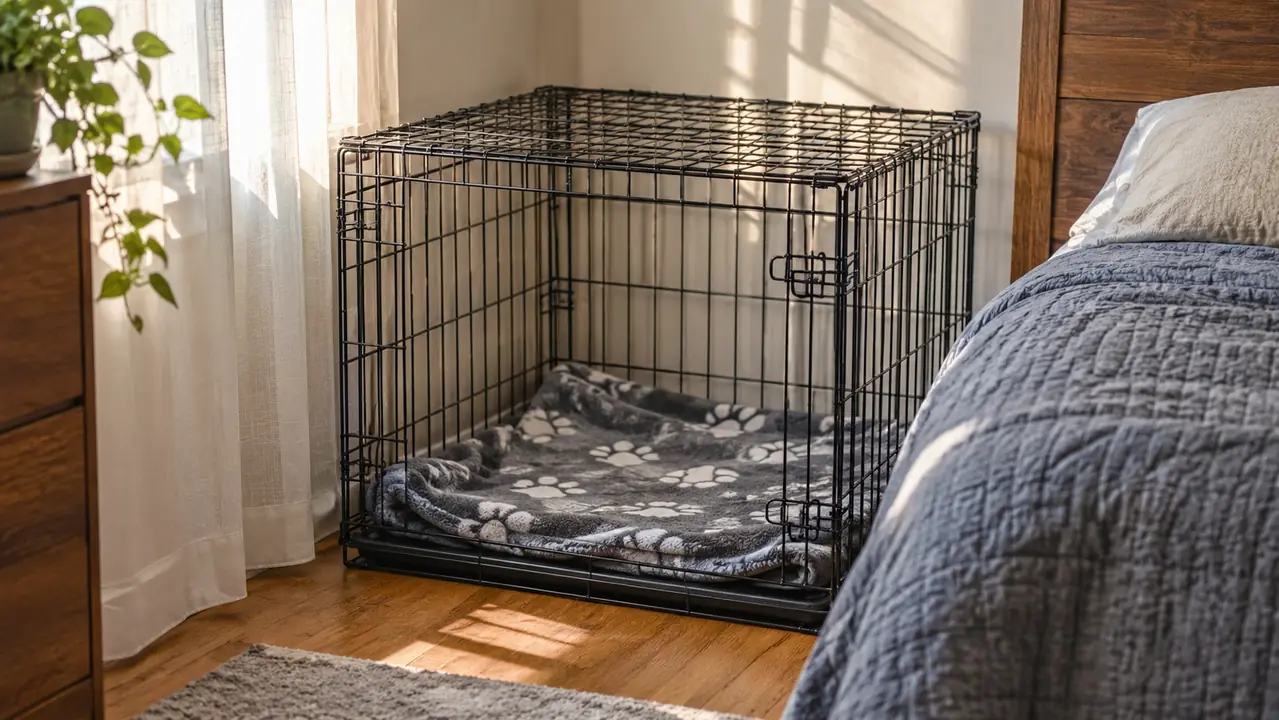
I bought the MidWest Homes for Pets 36-inch single door iCrate in the last week of February 2026, about a week before Moose came home from a shelter here in Myrtle Beach at roughly four months old. I owned no dog gear at all, not a crate, not a bed, not a leash of my own, so I sat at the kitchen table with a legal pad and read listing after listing the way I used to audit a chart. For the first ten nights I was certain I had picked wrong. He cried, I lay there listening, and Gary said more than once to just put the dog in the bed with us. The crate itself turned out to be the easy part of this year. The guessing around it was the hard part, and that is what I want to tell you about.
Here is the honest summary up front. This is a plain metal wire crate that folds, and nothing about it trains a dog. What it did in our house was give a nervous puppy one square of floor that never changed while everything else about his life did. Moose is about a year old now, close to 45 pounds, and he sleeps in it every night with the door open and walks in on his own. I have also barked my shin on the frame in the dark, listened to him rattle the wire at two in the morning, and once taken the whole thing apart to fish out a chewed sock. So this is not a love letter. It is what I would say to a friend who just adopted.
The Quick Verdict
A plain wire crate with a divider panel in the box, which let me buy one size instead of two. It does not train your dog and it is not quiet, but ours has held up to nine months of a 45 pound chewer without loosening.
Amazon Check Today's Price →Sized once instead of twice, because the divider comes in the box
The 36-inch single door iCrate measures 36.5 by 23.25 by 24.75 inches and ships with the divider panel and a removable, leak-proof tray. Ours held a four-month-old puppy at eighteen pounds and it holds a year-old dog at forty-five.
Amazon Check Today's Price on Amazon →How I've Actually Used It
The crate arrived folded flat and stood up in the corner of our bedroom, on my side of the bed, in less time than it takes me to make a bed badly. The listing says tool-free assembly and that is accurate, no screwdriver, no little bag of bolts to lose behind the nightstand. It weighs 22 pounds and has a carry handle on top, so in April, when my sister visited and the guest room needed to be quiet, I picked the whole crate up, carried it down the hall, and carried it back three days later.
Day to day it is simple. The door stays open while I am home and he comes and goes, mostly to nap after a walk on the beach access path. At night the door is closed and he sleeps. When I run errands he gets a frozen KONG in there and the door is closed until I get back, which is never long. The first month the door was closed more often, because he was into everything. I want to be straight with you that closing a door is not the same as teaching a dog to settle. The crate held him. The KONG and time and a lot of short trips out the door did the rest.
Cleaning is the part nobody mentions and it is the part I do every week. The tray slides out, and the listing calls it leak-proof, which has survived one sick night and a knocked-over water bowl. I carry the tray to the kitchen sink, wash it with warm water and dish soap, dry it, and slide it back under the floor of the crate. The rubber feet keep the frame from walking across the floor when he shifts his weight. I vacuum underneath every time, because a short tan coat plus a wire floor equals a small gray wig in that corner within a week.
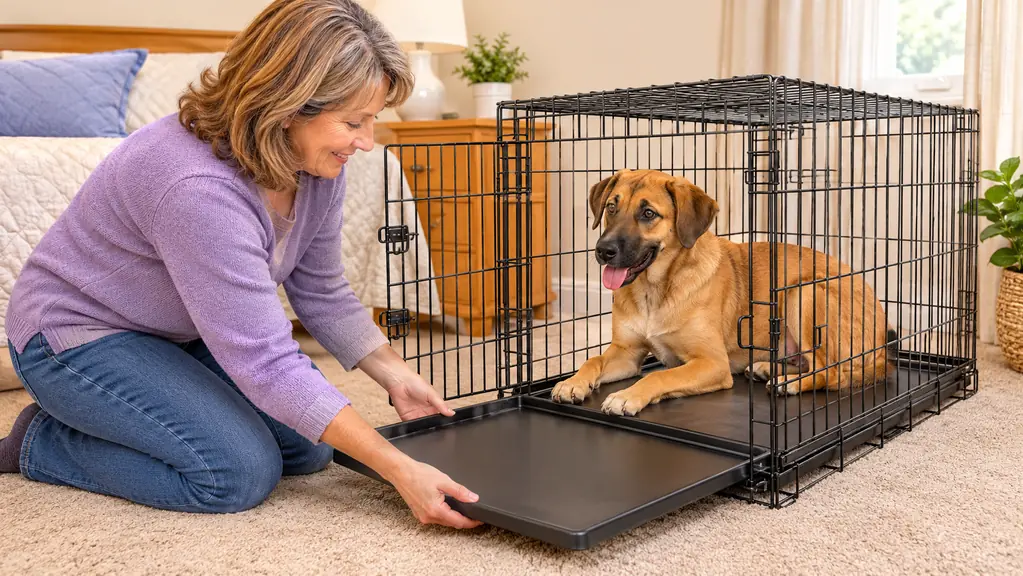

Sizing a 45 Pound Dog Into a 36-Inch Crate
The listing puts the 36-inch at medium to large breeds, 41 to 70 pounds, and names a few. I did not size to the puppy standing in front of me, who was maybe eighteen pounds and all legs. I sized to the dog I thought he would be, based on the shelter's guess that he is a mix of shepherd and hound, and then I got lucky. He is about 45 pounds at a year, right in the middle of that range, and I am aware that a braver guess in either direction would have made this a different article.
The numbers that mattered to me were these. The crate measures 36.5 inches long, 23.25 inches wide, and 24.75 inches tall, and the item dimensions are listed as 36 by 23 by 25. He can stand up without his ears brushing the top, turn around without folding himself in half, and lie flat on his side with room left over. Before I ordered I measured him from his chest to the base of his tail, and then I measured the corner of the bedroom, because a crate that does not fit your room is a crate you will resent every night.
The gap size is listed at 37.5 millimeters, which I checked because a four-month-old puppy's nose is a small thing and I wanted to be sure his jaw could not go through the wire. It could not. If you have a much smaller puppy or a small breed, that one number is worth looking at before you buy any wire crate, not just this one.
The Divider Panel Is Why I Only Bought One Crate
The divider panel comes in the box along with the removable tray, and it is the reason I did not buy a small crate in March and a big one in July. I set the panel so he had roughly a third of the length at first, which felt unkind for about a day and then clearly did not, because he settled faster in the smaller space than he had in the whole crate.
I moved the panel back twice as he grew, once in April and once in the second half of May, and I took it out completely in June. Three adjustments, no tools, no swearing. When it came out, the crate went from a kennel to a bedroom, and because he had already been sleeping in there for months, the change did not upset him at all.
I want to be careful here, because I am not a trainer and this is one dog. The smaller space helped us with house training, and I think it helped because he did not want to soil where he slept, which is the oldest advice in the book and not my own discovery. It also means a puppy can be shut into a space too small to turn around in if you set the panel wrong, so watch your dog for the first few days and give him enough room to stand up and turn. If house training is going badly after a couple of weeks, that is a conversation with your vet or a certified trainer, not a reason to buy a different crate.
The Parts of the Listing That Turned Out to Matter
MidWest Homes for Pets is a family-owned business out of Indiana, the listing mentions more than a hundred years in pet products, and the warranty is one year against manufacturer defects. I have not needed the warranty. What I did need was to know the thing would not fold up on my dog in the night, and the frame has not so much as loosened in nine months of him throwing himself down in it.
The tray is removable and the crate folds flat, which sounds like filler until you have to move it. Folded, it slides behind the guest bed or stands in the garage against the wall. Set up, it is a piece of furniture I have stopped noticing, which is the highest compliment I can pay anything in a bedroom.
The footprint is worth thinking about before you order, because this is not a small object in a small room. Ours runs 36 inches along the wall and takes up the corner between my nightstand and the closet door. In this one-story ranch house that is fine. In the apartment we lived in for two years before we moved south, it would have been the difference between walking past the bed and turning sideways. MidWest Homes for Pets lists the outside dimensions plainly, so take a tape measure to your corner before you choose between this and a 30-inch.
The lockable door is the one feature I use every single day and never think about. It shuts with one hand while the other hand is holding a KONG. He has never gotten out. He has rattled it hard enough to make me look up from my crocheting, which brings me to the things the listing does not say.
What Nobody Warns You About: The First Ten Nights
A wire crate is not a cave. It is see-through on every side, and a puppy who has just lost his litter, his shelter run, and everything he knew can see the whole bedroom and still be alone inside a wire box. Moose cried for about ten nights. Not all night, but enough that I got up, sat on the floor beside the crate with my fingers through the wire, and did not let him out. On night eleven he walked in on his own while I was still holding the KONG, and that was the end of the crying.
What helped was a fleece blanket on the floor of the crate, the KONG at bedtime, and a light throw draped over the top and two sides with the front left open so air moves and he can see out. What did not help was covering all four sides, which I tried for exactly one night and regretted at three in the morning when I woke up worrying about him.
The noise is real and I would rather you heard it from me. Wire carries sound. If your dog shakes himself off, you will hear the tags on the collar hit the bars, and if he digs at the floor you will hear that too. This is not a quiet crate and nobody should tell you it is. It is also not something you can tuck into a hallway and forget. Ours is in our bedroom and I still hear him settle at night.
What This Crate Does Not Do
It does not stop a chewer. Moose is a chewer, and he chewed a sock through the wire, which is how I ended up taking the whole crate apart on a Saturday. It does not fix separation distress either. If your dog is hurting himself on the bars, bending them, or working himself into a panic, that is not a crate problem and no crate on the market will solve it. Talk to your vet and to a certified trainer. I mean that plainly, and I am not qualified to advise you past that point.
It is listed for indoor use, and that is how we use it. It is not a crash tested car crate and I would not treat it as one, folded into a back seat or otherwise. And it does not house train a dog by itself. It is a room with a door. The training is the work you do around it, which in our house was a clicker, a frozen KONG, a rubber mat with yogurt spread thin on it, and a great deal of walking out the front door and coming straight back in.
What I Liked
- Divider panel included, so one crate went from puppy to full size with three adjustments and no tools
- 36.5 by 23.25 by 24.75 inches fit a 45 pound dog standing, turning and lying flat
- Removable leak-proof tray washed clean after a sick night and a spilled bowl
- Folds flat, weighs 22 pounds, carry handle on top, tool-free assembly
- One year warranty against manufacturer defects, and the frame has not loosened in nine months
Where It Falls Short
- Wire is loud. Tags, digging and shaking all carry through the house
- Not a cave. See-through on all sides, which made the first ten nights harder
- Listed for indoor use, so it is not a travel or car crate
- No cover included, and covering all four sides was a mistake I made once
- Hair and crumbs collect under the tray, so it is a weekly job whether you feel like it or not
He cried for ten nights. On the eleventh he walked into the crate on his own while I was still holding the KONG, and that was the end of it.
Who This Is For
If you are bringing home a medium or large puppy and you want to buy one crate instead of two, this is a sensible way to do it. You size for the adult dog, you use the divider while he is small, and you adjust as he grows. It also suits a household where the crate lives in one room and gets folded away when family comes, because 22 pounds and a handle on top make that a one-person job even at my age.
It suits a dog who is nervous rather than panicked. Moose was nervous. He cried, he settled, and by the end of the first month he was choosing the crate by himself in the middle of the afternoon. If that sounds like your dog, a plain wire crate with a blanket over three sides is a reasonable place to start, and the divider means you are not shopping again in four months.
Who Should Skip It
Skip it if your dog is a serious escape artist or hurts himself trying to get out. Wire bends. A dog in real distress needs a plan from a certified trainer and a conversation with your vet, and possibly a different kind of enclosure altogether. I am not the person to advise you on that, and I would be doing you a disservice to pretend otherwise.
Skip it if you need a crate for the car, because the listing says indoor and I believe it. Skip it if you want something that reads as furniture in the living room, because this reads as a wire crate and always will. And skip the 36-inch if your adult dog is going to be well over 70 pounds. The listing names 41 to 70 and I would take that seriously rather than hoping, which is the exact mistake I was afraid of making when I sat at the kitchen table with my legal pad.
If you are only going to guess once, guess with a divider in the box
The 36-inch single door iCrate comes with the divider panel, the removable tray, a carry handle and a one year warranty against manufacturer defects, and it folds flat when you want the floor back. In our house it held a four-month-old puppy at eighteen pounds and it holds a year-old dog at forty-five.
Amazon Check Today's Price on Amazon →