

The shelter volunteer said two words to me the day we finished Moose's paperwork: clicker training. I nodded like I knew what she meant. I did not. I was 57, retired from a dental office, and this was the first dog I had trained myself as an adult. I went home, sat on the kitchen floor with a puppy who was mostly legs and floppy ears, and typed clicker training into my phone. A few days later I ordered the Starmark Pro-Training Clicker. That was late March 2026. Moose was about four months old, maybe 20 pounds then, and he had already chewed a table leg and Gary's slippers. I wanted a tool that would help me tell him when he got something right. What I got was a small tool with a metal click, a lot of opinions from the internet, and a lesson in timing I did not expect.
This is the honest version of that purchase, not the clean version I wish I could tell. A clicker is not a remote control for a dog. It does not make a puppy sit because you bought it. In our house it helped me mark the exact moment Moose did something I wanted to see again, and that was worth something. But it took me a week to stop clicking late, and I still have days when my hands are full and the clicker stays on the hook. If you are looking for a tool that fixes jumping, barking or fear by itself, this is not that. If you want to get better at telling your dog yes at the right second, keep reading.
The Quick Verdict
A simple, sturdy marker that made my timing better. It will not train the dog for you, and the first week felt clumsy.
Amazon Check Today's Price →The clicker I would buy again if I were starting over with a rescue puppy
No batteries, no app, no screen. The listing says it attaches to a keychain, and ours lives on the hook by the back door with the leash.
Amazon Check Today's Price on Amazon →What Nobody Tells You About a Clicker
The first thing nobody tells you is that the clicker is not for the dog. It is for you. The click is a marker, a short sound that says that exact thing, right there, is what pays. The treat comes after. If you click and then fumble for a treat for four seconds, you are marking the fumble, not the sit. I did this for days. Moose would sit, I would click, then I would dig in my pocket while he stood back up. He was learning that standing up after a sit paid. Gary watched this for a week before he said, gently, that I was rewarding the wrong end of the dog.
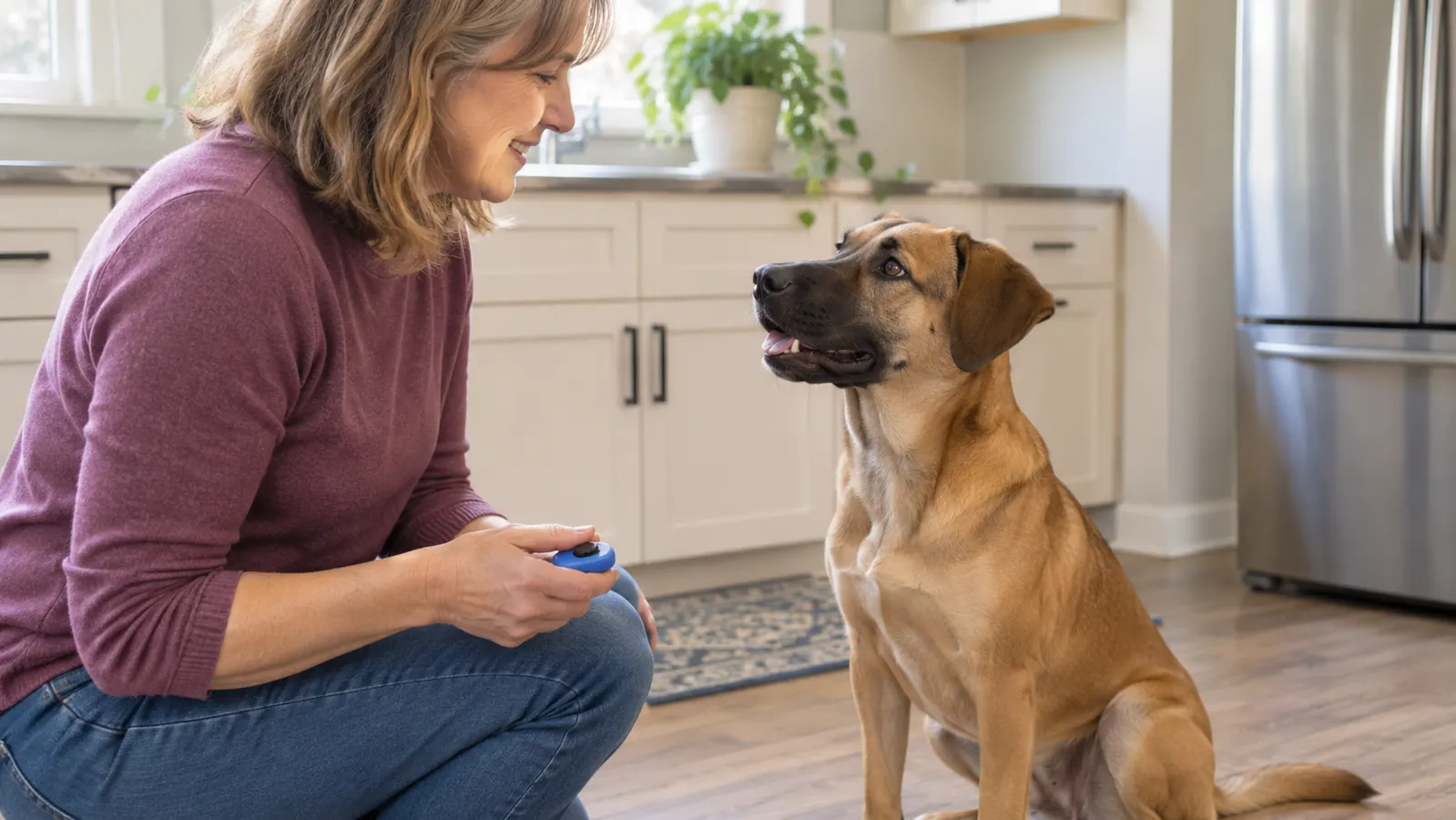
The second thing nobody tells you is that you have to charge the click before you use it. That means clicking and treating, clicking and treating, with no behavior attached, until the dog hears the click and looks for the treat. I did this in the kitchen for about three days, maybe ten clicks a session, two sessions a day. Moose caught on faster than I did. By the end of the first week, his ears would lift at the click. That was the whole point. The clicker did not teach him anything. It just made the treat arrive with a clear timestamp.
The third thing is that timing is a physical skill, and I was bad at it. A clicker is small, about 0.8 by 1.5 by 2.3 inches according to the listing, and it fits in my hand, but my hand was slow. I would see Moose sit and then click a half second later. In dog time, that half second is a different event. I fixed it by holding the clicker in my right hand and the treats in my left, and by clicking the instant his rear hit the floor, not after I felt pleased about it. That sounds simple. It was not simple for me.
The fourth thing is that a clicker is not a complete training plan. It marks behavior. It does not tell the dog what to do instead of jumping, and it does not make a nervous dog feel safe. I used it for sit, down, and four paws on the floor at the door. I did not use it for Moose's nervousness around new people, because I did not know what I was doing there and I did not want to mark the wrong thing. For anything beyond basic manners, I would talk to a certified trainer. I am a retired dental office manager with a rescue puppy, not a behaviorist.
The fifth thing is that the clicker does not replace patience. Some days Moose was distracted by the beach smell on the wind or a lizard on the fence, and no small click was going to compete with that. On those days I put the clicker down and tried again later. The tool is only as good as the session you bring to it. If you are rushed, frustrated, or already late for an appointment, the clicker will not make you a better trainer in that moment. It will just be a small thing in your hand while you sigh.
What the Starmark Clicker Actually Is
The Starmark Pro-Training Clicker is exactly what the name says: one training clicker. The listing lists one training clicker as the included component, and that is what arrives. It is 0.8 by 1.5 by 2.3 inches and weighs 0.4 ounces, or 11.34 grams. It has an ergonomic shape that fits comfortably in your hand, according to the listing, and a stainless steel clicker element that the listing says will not rust. It is water resistant, lightweight and portable. It easily attaches to a keychain. There is no app, no screen, no battery door, and nothing to charge. I know that sounds like a low bar. After a year of puppy gear, a tool with no setup was a relief.
The metal element matters more than I expected. I keep the clicker on the hook by the back door with the leash and harness, and it has been dropped on the kitchen floor more than once. It still clicks. The listing says the stainless steel element will not rust, and I have no reason to doubt it, though I have not left it outside in the rain. The body is small enough that I can hold it and a handful of kibble in the same hand if I need to. The size is also the downside. It is small enough to lose. I have found it in the pocket of my gardening apron twice and on the floor of the car once.
The ergonomic part is not marketing fluff in my case. I have some arthritis in my right thumb, and I can click this with a small press rather than a full squeeze. I do not have to look at it. That matters when I am watching the dog. The click is sharp enough that Moose hears it across the kitchen, but I would not call it silent. In a quiet house, Gary can hear it from the other room. If you have a sound-sensitive dog, test the sound before you build a whole training plan around it. I did not, and Moose was fine, but I would not promise that for every dog.
The click did not make Moose sit. It made me notice the exact second he did.
How It Went in Our House
We started in late March 2026 with sit. Moose had come home in early March, about four months old, and he had the attention span of a gnat. I put a piece of kibble in my hand, waited for his rear to touch the floor, and clicked. The first session was maybe three minutes. The second was five. By the end of the week he would sit and look at me when he heard the click. I did not use the clicker for his name, for come, or for leash walking. I kept it narrow, because I was learning too.
In April I started using it at the front door. Moose jumped on guests. He was not aggressive, he was a happy puppy with no manners, and he was about 25 pounds by then. I would have a friend ring the bell, and I would ask Moose to sit. If all four paws stayed on the floor, I clicked and treated. If he jumped, nothing happened. That was the hard part. Nothing happening felt like I was not doing anything. But over April, May and June, the sit at the door became his default. He still gets excited. He still wiggles. But he sits now before I open the door, and that is a change I can see.
The clicker also taught me how often I was late. I would wait for Moose to sit, then reach for a treat, then click. That was backwards. I fixed it by keeping the clicker in my right hand and the treat in my left, and by clicking the second his rear touched the floor. I also started using a verbal marker, the word yes, for the times I did not have the clicker. That is a separate article, but the short version is that the clicker made my yes better. It gave me a physical habit of marking the exact second instead of the general idea.
Now, in November 2026, Moose is about a year old and 45 pounds. The clicker still hangs by the back door. I use it a few short sessions a week, mostly for new things like waiting at the curb or going to his mat while I fix dinner. I do not use it for every meal or every walk. I do not think a dog needs a clicker forever. I think it is a teaching tool, and once the behavior is learned, you can fade it. In our house, it earned its hook.

The Honest Downsides
The first downside is the one I already mentioned: it is small, and small things get lost. If you are the kind of person who loses your keys, you will lose this clicker unless you pick a home for it. Mine lives on the same hook as the leash. That is the only reason I still have it. The keychain attachment is there, but I do not carry it on my keys because I do not want to click every time I unlock the car.
The second downside is that it is a tool for a human who is willing to practice. If you are not going to click and treat a few times a day for a couple of weeks, the clicker will not do much. I had a week in April when I was tired and I skipped it. Moose did not forget everything, but I did. My timing got rusty. That is not the clicker's fault. It is still a commitment.
The third downside is that it does not solve fear, aggression, or severe anxiety. I want to be clear about that. If your dog is biting, freezing, or panicking, a clicker is not the first tool I would reach for. Talk to your vet or a certified trainer. I used the clicker for manners, not for anything medical or dangerous. I also would not use it on a dog that is too sound-sensitive to tolerate the click without a careful introduction.
The fourth downside is the sound in a quiet room. It is not loud, but it is sharp. If you have a puppy who startles at every noise, introduce the click from across the room with a treat, not right over the dog's head. I did that with Moose because I had read too much before I started. It worked. I would not skip that step for a nervous dog.
The fifth downside is that it can become a crutch if you let it. I caught myself reaching for the clicker for every little thing, including things Moose already knew. That is not the clicker's fault either, but it is a habit to watch. A marker is for teaching, not for narrating your dog's whole day. Once Moose knew sit at the door, I faded the click and kept the treat and the praise. The behavior held.
What I Liked
- Small and light, easy to keep on a hook or in a pocket
- Stainless steel element, and the listing says it will not rust
- No batteries, no app, nothing to charge
- Ergonomic enough for my arthritic thumb
- Attaches to a keychain if you want it on your keys
Where It Falls Short
- Easy to lose because it is small
- Sharp click can startle a sound-sensitive dog
- Does nothing without treats and consistent timing
- Not a fix for fear, aggression or severe anxiety
- Can become a crutch if you click for everything
Who This Is For
This is for the person who just brought home a rescue puppy and wants a simple way to mark good behavior. It is for the person who has treats and five minutes and is willing to be clumsy for a week. It is for the person who wants a tool with no setup, no charging, and no screen. If you are training basic manners like sit, down, wait, and four paws on the floor, the Starmark clicker is a reasonable place to start. It helped us. I would buy it again.
Who Should Skip It
Skip it if you want a device that trains the dog for you. Skip it if you are not going to carry treats. Skip it if your dog is aggressive, severely anxious, or panicking, and get professional help first. Skip it if you know you will not practice. And skip it if you already have a verbal marker that is working for you and your dog. The clicker is not a requirement. It is a preference. In our house, it was a useful one, but Moose would still know sit without it.
If your yes keeps landing a second too late, this is the fix I used
One clicker, a handful of kibble, and three minutes in the kitchen. That is how we started.
Amazon Check Today's Price on Amazon →