
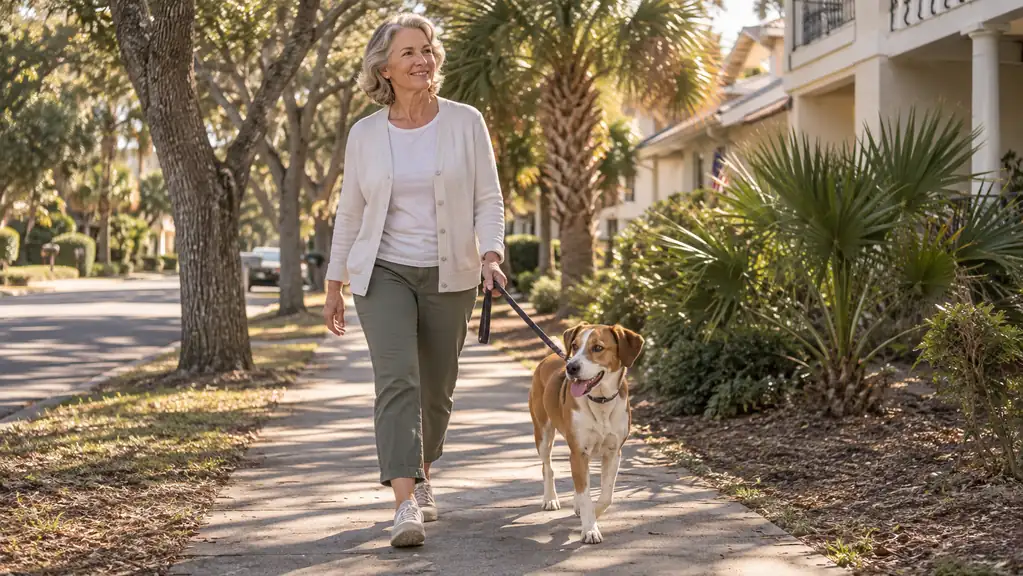
The first time I clipped the leash to the front of a harness instead of Moose's collar, he walked sideways for half a block. I stood on the sidewalk on a Tuesday morning in May, holding a thirty-five pound dog who had suddenly decided to travel like a crab, and I thought I had made a mistake. Moose is the rescue pup my husband Gary and I adopted in March, a mixed breed the shelter guessed at, and he came home with a plain flat collar and a basic leash and no idea at all how a walk was supposed to go. By May my right shoulder ached after every loop around our neighborhood. That is when I ordered the PetSafe Easy Walk harness in a size Large, and it has been on him for every walk since.
Here is what I want to be straight about up front. The PetSafe Easy Walk did not teach my dog to walk politely. It is nylon straps and a buckle, and it does one job, which is to move the pulling off my arm and put it somewhere Moose can feel. Everything else, the sitting at curbs, the waiting while a jogger goes past, the not dragging me toward every squirrel between here and the beach access path, that came from a clicker and a pocket full of treats and about four months of short, repetitive, occasionally embarrassing practice in front of my neighbors.
The Quick Verdict
A well-made management tool that made our daily walks possible again. It is not training, it needs a careful fit, and it does nothing about squirrels. Six months in, I would buy it again.
Amazon Check Today's Price →The harness that got my shoulder out of the argument
It will not teach loose leash walking. It buys you the calm hands you need while you teach it, which in our house was the whole problem.
Amazon Check Today's Price on Amazon →Why I Bought It, and What I Actually Expected
I did not shop around. My shoulder hurt, a neighbor two streets over walks a big lab mix in one of these, and she told me it was the only reason she could still take him out. I read the listing, which says the martingale loop design puts gradual pressure on the dog's shoulders, and I remember thinking that sounded like a polite way to describe something that probably yanks. So my expectations were low. I figured I would get a slightly less miserable walk and a sore shoulder anyway, and I figured I would be back to hunting for something else by June.
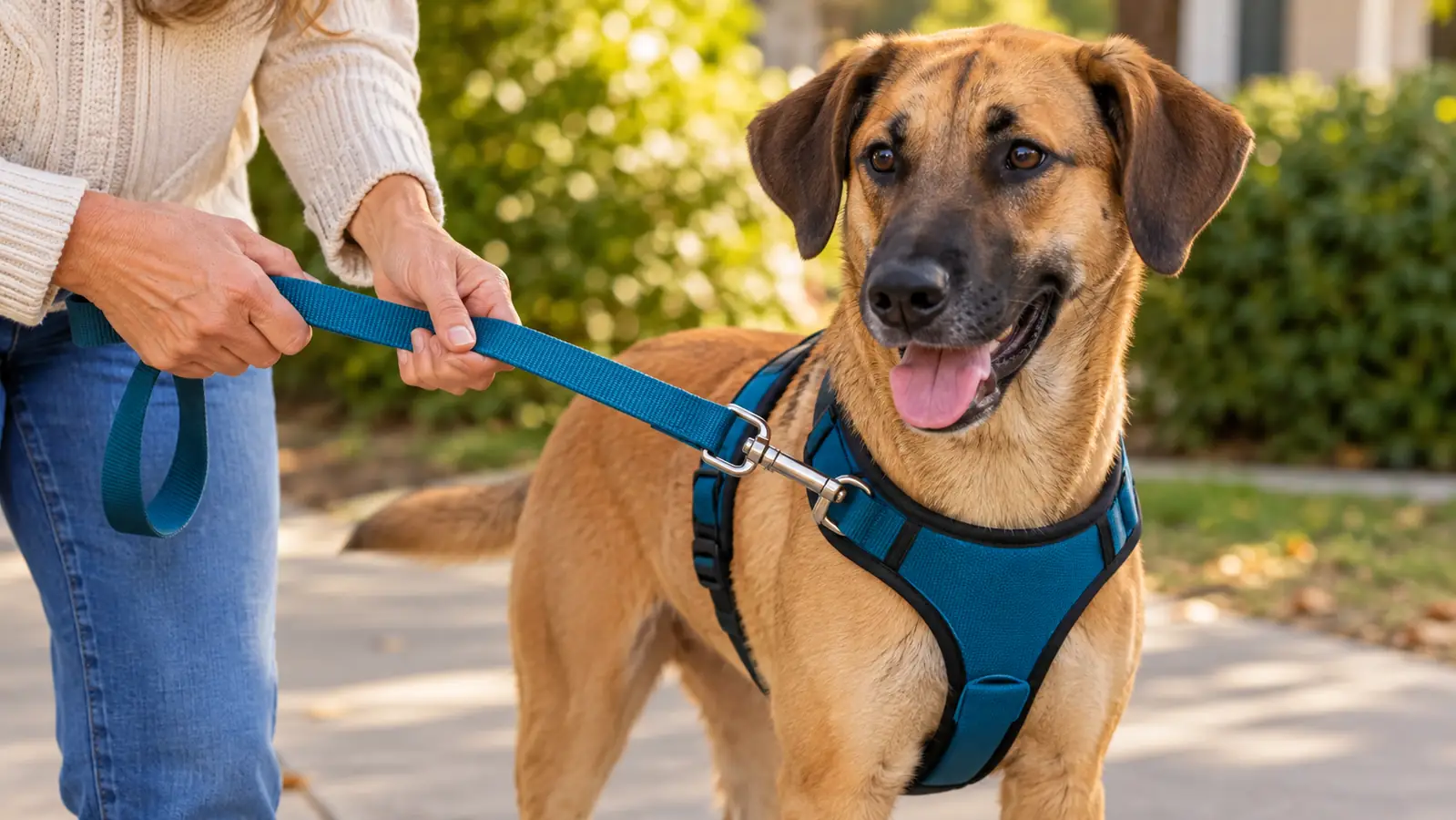
What I got instead surprised me on the second walk, not the first. The first one was the crab walk. The second one, Moose hit the end of the leash like always, and then he swung back toward me instead of leaning into it, and we kept moving. The leash attaches at the chest on this harness, so the pressure lands across the front of him instead of his throat, and that changed the whole shape of the walk. He could still pull. He just could not get the same leverage out of it, and neither could my shoulder.
The part I did not expect is how much of the work stayed mine. A front clip harness is a management tool and nothing more. It buys you a dog who is not choking himself while you teach the actual lesson, which is that a slack leash pays and a tight one does not. If you clip this on and stop there, you will have a dog who pulls in a slightly different direction for the rest of his life. I know that because I stopped there for about three weeks and wondered why we had plateaued.
What Comes in the Box, and What Does Not
The box is small and honest. It holds the harness and a quick start guide, and that is the whole list. The harness is nylon, it closes with a buckle, and the shoulder straps have quick-snap closures that make it easier to get it over a wiggling dog's head and settled. The belly strap is a different color from the shoulder straps, which sounds like a small thing until you are standing in the dark on a November morning trying to work out which strap goes under and which goes over. Mine is a size Large. He was about thirty-five pounds when I bought it and he is about forty-five now, and there is still adjustment left in the straps. The PetSafe listing says the design came from a veterinary behaviorist in 2004, which I did not know at the time and which explains the shape of the thing.
What does not come in the box is a leash, treats, or a plan. You will want all three. The quick start guide is better than most, especially the fitting diagram, but it is a leaflet and not a training program. The care instructions say hand wash only, so this is a sink job with a little dish soap, not something you throw in the machine with the dog blankets. It carries a one year manufacturer warranty, which I have not had to use.
The Fitting Is the Whole Thing, and Nobody Warns You
Nobody told me that fitting is not a one time job. The first time I put it on Moose it looked right and it was not. He was between sizes in the shoulders and I had the chest strap too loose, so the whole harness rotated on him about ten minutes into the walk and the clip ended up under his elbow instead of on his chest. He stopped dead in the middle of the sidewalk and looked at me like I had betrayed him. I went home, took it off, read the leaflet again, and started over.
What worked in our house was checking the fit every single time for the first month. Two fingers under each strap, snug but not tight, and the front strap sitting level across the chest instead of sliding down toward his armpits. He grew twice that summer. I refit the straps in June when his chest widened, and again in August when he went through a lanky stage and the shoulder straps needed to come in. If you fit it once at the start and never look again, you will be walking a dog in a harness that stopped fitting him a season ago.
I also learned to watch for rubbing. On one long Saturday walk, about three miles on the beach access path, I noticed a pink spot where the strap had been sitting behind his front leg. That was mine to fix, not the harness's fault. The fit had gone slack again and the whole thing had been sliding, and once I snugged it up the spot faded in two days. If your dog has thin skin, a healing wound, or reacts badly to straps anywhere on his body, talk to your vet or a certified trainer before you push through it. A harness that rubs a raw spot is not helping anybody.
Six months in, the harness has not taught Moose a single thing. What it has done is keep my shoulder out of the conversation long enough for the treats to do the teaching.
What Six Months of Walks Actually Look Like
Our routine now is a morning loop before the heat comes up and a shorter one after dinner. He still wears his flat collar with his tags, and the harness goes over it. The leash clips at the chest, I hold it in my left hand with a few feet of slack, and most mornings that slack stays there. Most mornings. When a squirrel breaks cover he still hits the end of it and I still get a jolt, but it is a jolt I can hold with one hand instead of a jolt that pulls me off balance.
The change that matters to me is not really about the pulling. It is that I stopped dreading the walk. For about six weeks in April and early May, I was cutting our loops short because my shoulder could not take the second half. Now we walk the full loop and we work on things while we do it. A sit at each corner. A wait before we cross. A look at me when a jogger goes by. None of that came from the PetSafe harness. All of it got easier because the harness made the walk manageable enough that I had a free hand for a treat.
He has outgrown the fit twice and we are probably due for another look before the holidays. The nylon has held up with no frayed edges and no stretched buckle, and the straps stay where I set them now that he has stopped growing. I wash it by hand in the sink every couple of weeks and hang it over the back of a kitchen chair to dry. It is not a pretty piece of gear after six months of salt air and sand, but it is intact.

Compared to Walking Him on the Flat Collar
I want to be fair to the collar, because for a lot of dogs it is fine. Moose came home in a flat collar and we walked on that for two months. On a calm morning with nothing interesting in sight, he walked nicely on it. The trouble was that a calm morning is not something you can schedule, and the moment something interesting appeared, he would hit the end of that leash and the pressure landed on his throat. He would cough, I would jerk back, and we would both spend the next ten minutes rattled. That is not the collar being cruel. It is me being a first time owner with a strong young dog and no better idea.
The switch changed two things. The pressure moved off his throat and onto his chest, so the coughing stopped, which mattered to me more than the pulling did. And because the front clip turns him back toward me when he lunges, I got a half second to think before I reacted. That half second is where all the training happens. I still use the collar for his tags and for clipping him to a seatbelt in the car. I just do not walk him on it anymore, and I would not go back.
What I Liked
- Moved the pulling off my sore shoulder, which was the only reason I bought it
- Quick-snap shoulder straps make it fast to get on a dog who does not want to stand still
- The belly strap is a different color from the shoulder straps, which genuinely helps in low light
- Nylon has held up through six months of daily walks, salt air, and hand washing
- Sized Large with enough adjustment left to follow a growing puppy through two refits
- One year manufacturer warranty
Where It Falls Short
- The fit takes real attention and has to be redone as a puppy grows
- It does not teach loose leash walking on its own, not even a little
- A loose fit lets the harness slide and can rub behind the front leg
- Hand wash only, so it is a sink job every couple of weeks
- It does nothing at all about the squirrel
Three Things I Wish Someone Had Told Me
The first is that the first week can look worse before it looks better. Moose walked like a crab, he stopped and stared at me, he tried to mouth the strap that crosses his chest. I nearly sent it back. Then something clicked around day six and he settled into it. If you are on day two and your dog is walking sideways, that is not automatically the harness failing. That is a dog adjusting to a different feeling on his body, and it is worth a week of patience before you decide.
The second is that this is not a no-pull device in the way people usually mean it. It is a no-leverage device. Your dog can still pull. Your dog will still pull, on the days he really wants the thing at the end of the leash. What changes is how much of that lands on you. If you are expecting quiet walks with no training and no treats, you will be disappointed, and it will not be the harness's fault.
The third is that some dogs simply do not take to a strap across the chest, and that is a conversation for a professional. Moose was fine after a week. If your dog freezes, panics, or snaps at the harness, stop and talk to a certified trainer or your vet. Same if your dog has a history of biting, or severe fear on walks, or has started guarding things. That is not a gear problem, and no harness on the market will solve it for you.
Who This Is For
This is for the person with a dog who pulls hard enough to hurt, and a body that has started complaining about it. In our house it made the difference between walking the full loop and quitting halfway, and that difference spilled over into everything else we were trying to teach. It suits a medium or large dog with a chest deep enough to hold the straps where you put them, and an owner who will spend ten minutes on the fit and another few minutes a week checking it. If you are already working on leash manners and you just need the walks to stop being a fight, this is the piece of gear I would buy first.
Who Should Skip It
Skip it if you want a fix without a lesson, because you will not get one. Skip it if your dog has a skin condition, a healing wound, or a body shape that makes straps sit badly, and ask your vet before you buy. Skip it if your dog is fearful enough to shut down when something crosses his chest, or if you are dealing with reactivity, lunging, or bites, because those need a certified trainer and a plan, not a different clip. And skip it if you are not going to recheck the fit, because a loose front clip harness slides, rubs, and gives a determined dog enough room to back out of it. Fit it properly and check it often, or buy something else.
One shoulder, one dog, and six months of walks that stopped hurting
It is not training and it will not fix a hard case. It made our daily walks possible while the training caught up, and that was the whole ask.
Amazon Check Today's Price on Amazon →